


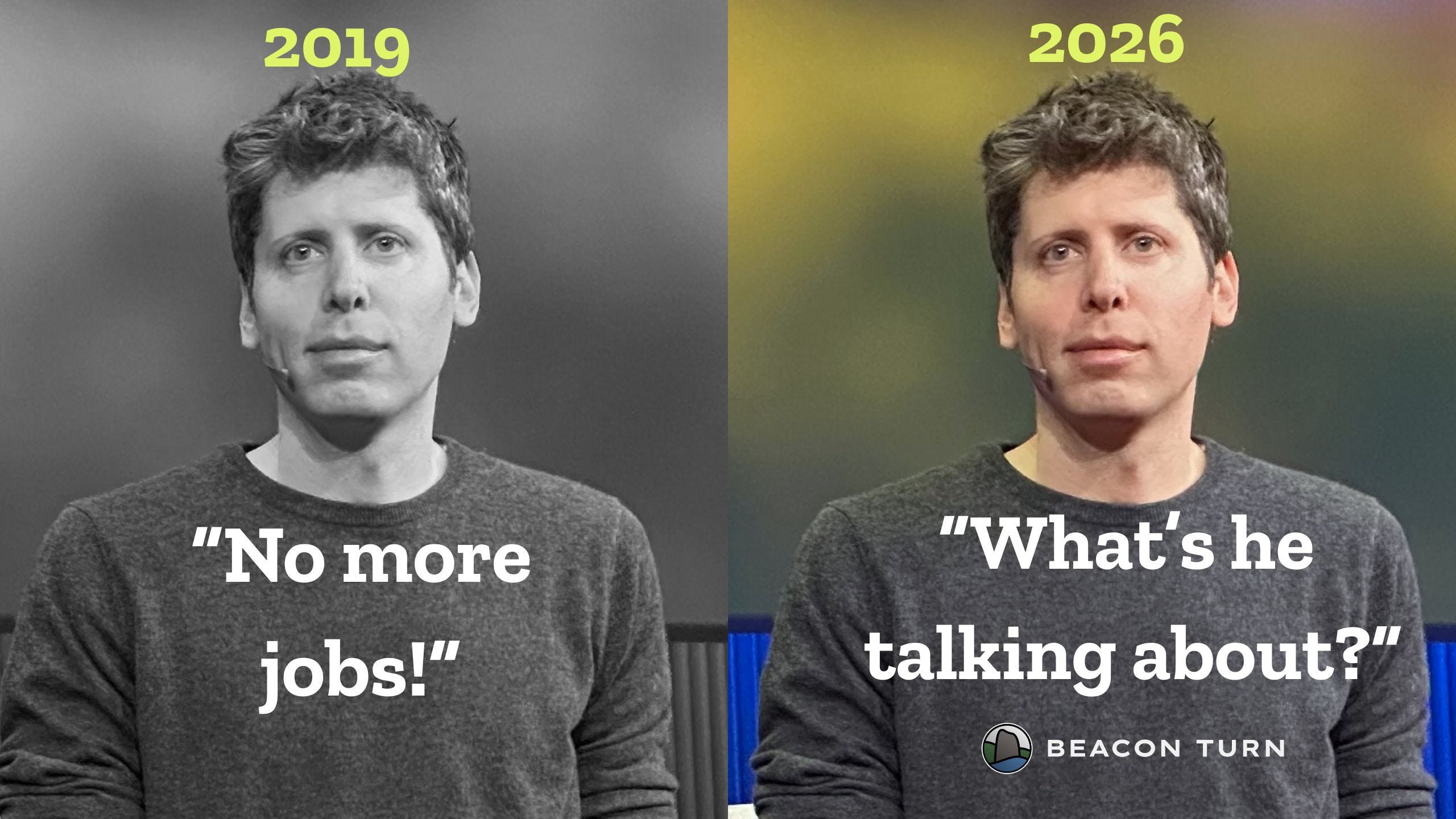
Sam Altman built his reputation partly on boldly predicting AI would gut the job market.
He told CNBC in 2019 that AI would “probably replace most of the jobs people do today.” In July 2025, he told Congress entire job categories would be “totally, totally gone.”
Ten months later, during a virtual interview at a Commonwealth Bank of Australia conference in Sydney, he said he doesn’t expect “the kind of jobs apocalypse that some of the companies in our space advocate or talk about.”
Some of the companies?
Hey, Sam, that was you.
This is the part of tech leadership I have zero patience for. The amnesia and lack of accountability for people who predict the future from positions of power. Altman goes from “totally, totally gone” in front of Congress to “that’s some other company’s rhetoric,” all inside a year.
What changed?
If you ask Microsoft’s Mustafa Suleyman, nothing. He thinks Altman’s initial prediction was right. He’s telling reporters that most white-collar work gets automated within the next 18 months.
Of course, he isn’t trying to line his company up for an almost inevitable record-breaking IPO.
But what’s really happening is really, really important. So who do we believe? We might get a lesson from the last time an industry swore a machine was about to make its jobs obsolete.
In the 1970s, ATMs were going to empty the teller line. Machines that dispense cash for free don’t need a human standing next to them. Lines at the bank would become a distant memory and bank tellers would fall the same way telephone operators did.
You didn’t have to be Sam Altman to make such an easy prediction. It was a widespread belief.
But it didn’t happen that way. Tellers per branch fell, sure, from 20 in 1988 to 13 by 2004, but cheaper branches meant banks opened more of them. Urban branch counts grew more than 40% over that stretch. ATMs didn’t stop growing either. There were 383,000 of them by 2004.
The teller job changed but it persisted. Then the smartphone showed up
Mobile banking did what the ATM never managed. You could manage money, make transfers, send wires, and do all kinds of complicated transactions from the device that lives in your hand.
I’ve been inside my own credit union maybe twice in the last five years. Teller employment went from about 332,000 in 2010 to 164,000 by 2022, and Bank of America alone closed roughly 40% of its branches between 2008 and 2025.
Even common sense is wrong sometimes.
Nobody at those banks was dodging IPO questions or lying to shareholders. They just watched the thing everybody was worried about while missing the thing that would actually make banking change for good.
So this isn’t really a piece about Sam Altman being full of it (even though he is). Post-IPO, his messaging will likely change again. The boy will cry wolf once again.
But it’s too easy to pick on him.
It’s about how hard it is for most people to see the real threat coming until it’s already inside the building, including people who have no reason to lie about it.
Watching the wrong door is a human problem. Never having to cop to it is a rich guy problem. Okay, maybe I’ll pick on him some more.
I get into the actual numbers on this in my Reworked column this week, including the CFO survey showing companies are cutting jobs faster than they can prove the AI paid for itself.
What else is going on this week?
Your AI Adoption Gap Is Actually an Adaptability Gap. Jess Von Bank argues the AI adoption gap is really an adaptability gap, and layering AI onto old processes is “like hitting 1.5 on a podcast playback to listen to it faster.” This is the correct read.
Acadian Ventures Inaugural Impact Report. Acadian’s first impact report counts 50-plus portfolio companies, $1.5 billion raised and more than 3,000 jobs created, and Jason Corsello and team are doing great work.
Thinking, Fast and Hired. Brian Fink‘s argument is that every recruiting tool sold as AI is “functionally, a System 1 machine,” and the fix is structured, consistent scoring. I love his advice to buy the software, then buy the book.
We Need Standards for AI in Hiring. David Manaster says recruiting lacks a standard for AI in hiring, so he drafted four, starting with a ban on auto-declines over criteria that weren’t stated upfront. He’s right, and while it’s tricky, that doesn’t mean it shouldn’t be done.
The Governance Series So Far: AI Governance 8. If you haven’t been keeping up with John Sumser‘s AI governance series, here’s the TL;DR, including his line that “the machine’s recommendation is officially optional and socially mandatory.”
Judgment Is the (OUR) Job Now. IBM found 71% of CHROs now call supervising and overriding AI the most essential skill, and Jason Averbook writes that 2026 proved the agent could do the work. I don’t even know if 2026 proved that, but agents can certainly make work.
How to Stop Thinking (A Whimsical Way That Works). We definitely need an overthinkers anonymous, and Kat Kibben‘s version involves hiding tiny dinosaurs for strangers to find.
HC Insider: September 2026. I don’t miss one of Kyle Forrest‘s newsletters, and this one has Deloitte’s new videos on HR jobs with AI agents in them.
The €10 Billion Deal HR and Payroll Leaders Should Be Watching. Anita Lettink reads Silver Lake’s Cegid and Silae merger and its reported Workday talks as investors deciding the payroll-in-HR-or-finance debate doesn’t matter much anymore. I don’t like platforms leading the way, but that’s what happens when you don’t have your own vision.
The Solution Premium Playbook: Why Software + Services Is Converging Now. Services firms are buying software companies at twice the rate software firms are buying services this year, according to Charles Bedard. I’m seeing this more too.
What if There Was TSA PreCheck for Recruiting?. Doug Berg is trying to solve the tricky problem of candidate fraud by verifying licenses and certifications before someone applies. He says Match2’s “certify to apply” approach has produced 90%-plus reductions in fake applies.
The Jobs Did Not Come Home........ I got introduced to a new term from Kristy McCann: “stability stacking,” Glassdoor’s name for layering skills, income and networks so no single job can knock you flat.
Who’s Flying the Plane?. Robin Schooling worries about never-skilling and mis-skilling as AI takes over routine work. If we never learn the easy stuff, we might mislearn the hard stuff.
The Fuel50 Acquisition: How Does This Make Sense?. University of Phoenix’s parent is paying about $31.5 million for Fuel50, roughly 1.5 times revenue by Steve Smith‘s math. I think it makes sense, and since it isn’t my money, I don’t care about the deal size.
ZoomInfo’s New Recruiting Product Has One Job: Prove the Data Is Good. ICYMI, here’s my take on ZoomInfo’s Talent Autopilot, including research from Madeline Laurano on why recruiters don’t trust vendor data.
The Future of Learning and Development. Smart write-up from Meg Bear on how L&D can help reimagine work instead of only leading AI enablement, part of what she and Amy Wilson have been pondering about agentic co-workers.
Grumpy PSA for HR Tech Founders. “If you say you are doing recruitment selection with AI and no one on your team has serious industrial psychology chops you are building a zodiac.” Thomas Otter should just register the grumpy PSA trademark at this point (he’s also right).
Women Applying AI on Womansplaining AI. Pam Boiros and Luda Kopeikina talked about Women Applying AI, the community they started, as it nears its first anniversary. Love the show’s title.
The Role Work Plays in Recovery. September is National Recovery Month, and I love this conversation between Jeanne Achille and Heather Bussing on the role work plays in substance use and recovery.
Business as Usual Was Never Stability: How to Lead When Disruption Is the Norm. Aaron Delgaty does tremendous work, including SparkEffect’s new Trust Report on disruption at work and the podcast interview that goes with it.
The Frontline Worker Expectation Gap. 84% of frontline workers value clear pay insight but only 57% are highly satisfied with it, one of the good insights on the gap Pete Tiliakos pulls from Workday and DailyPay’s white paper.
AI Adoption Is Driving Hiring, Though Mostly for Senior Roles. Stanford looked at 1.25 billion job postings and found senior employment at AI-adopting firms rose 6.7% over five years while junior employment fell 3%. More good news if you’ve got experience, but question marks remain for everyone else.
Indeed CEO Says the Job Market Is Stuck in a ‘Vicious Cycle’ if 1,000 Qualified Candidates Can’t Get Hired: ‘Something’s Wrong’. Doesn’t Indeed play a role here though, though?
HR Tech 2026 Announces 33 Contestants for Industry’s Most Popular Startup Competition. I’m looking forward to seeing the 33 startups George LaRocque and the Pitchfest team picked from 80-plus applicants for next month’s HR Tech.
Workday Stock Rallies Following Reports of Ongoing ‘Go Private’ Financing Efforts. CNBC is hearing “a bit more optimism” about financing a Workday take-private, but nothing is confirmed yet. I’m starting to hit the “I’ll believe it when I see it” stage, but I’m also not a speculative investor.
What the Apple-OpenAI Trade Secrets Fight Means for HR. With all the talk about AI, the Apple lawsuit against OpenAI is a reminder that getting the basics right is still critical.
Only 58% of Employees Say Leaders Have Explained How AI Serves Company Goals. Culture Amp found 85% of employees say they’re encouraged to experiment with AI, but only 58% say leaders have explained how it serves company goals, and explainability matters here. Amy Lavoie adds that seven in ten feel more productive with AI while their workload scores haven’t moved.
Video: The HCM Technology Utilization Gap: Why 87% of SMBs Aren’t Using Their Platforms to the Fullest. Dylan Teggart gives a good rundown of why only 13% of business leaders in 3Sixty’s research with Insperity feel they fully use their HR platforms, from weak implementations to poor support.
Have a great rest of your week!