



ZoomInfo launched Talent Autopilot today, an AI agent built to reason across a database of 500 million professional profiles and surface recruiting candidates that keyword search would never catch.
For the last decade, every sourcing vendor's opening line has been a number, usually hundreds of millions of profiles. Every time, I ask the same question: Are they any good? Are they right?
Most vendors get defensive back. There’s bad data everywhere, they’ll tell you. Here’s a tool to sort through it. And, more recently: look at the AI.
That’s always the solution.
In my experience, recruiters’ actual complaints are rarely about volume. It’s saliency and accuracy. You don’t need another message that reads, “I noticed you’re a VP of Engineering at Acme. I’m hiring for a similar role at a company you’ve never heard of.”
ZoomInfo is really selling trust in its own data, not simply a smarter agent.
That might be an uphill climb from a company that told Wall Street its own AI story confused customers enough to cut its guidance this spring.
Recruiters Trust Their Data. Their Data Doesn’t Deserve It.
Madeline Laurano's Aptitude Research found that 77% of respondents would eliminate or downgrade a vendor that can't explain how its data is sourced and verified, in research ZoomInfo cited in its own launch announcement.
The rest of the numbers come from the leave-behind ZoomInfo handed out at its analyst briefing last week.
74% of recruiters say they're confident their candidate data is accurate
61% believe at least a quarter of their ATS records are already stale
62% say candidate information goes bad within three months
61% spend four or more hours a week manually fixing it by hand
Those are real problems that ZoomInfo believes it can solve.
What Talent Autopilot Actually Does
I’ve talked to ZoomInfo a handful of times over the years, out of personal interest and because the company has spent years trying to prove its data banks could do more than fuel sales and marketing lists.
Instead of matching on titles and keywords, the agent takes a hiring objective and reasons across skills, experience, career paths and company intelligence to surface candidates who wouldn’t turn up in a normal search. “They need technology that understands what they are trying to accomplish,” said Jon Bischke, general manager of ZoomInfo Talent Solutions, in the launch announcement.
Recruiters plug in the role, review what the agent finds, and refine it with plain-language feedback. Approved candidates get pushed into an ATS with duplicate detection, then reached through connected Gmail or Outlook accounts with personalized outreach and one automatic follow-up. More importantly, nothing goes out until a recruiter clicks send.
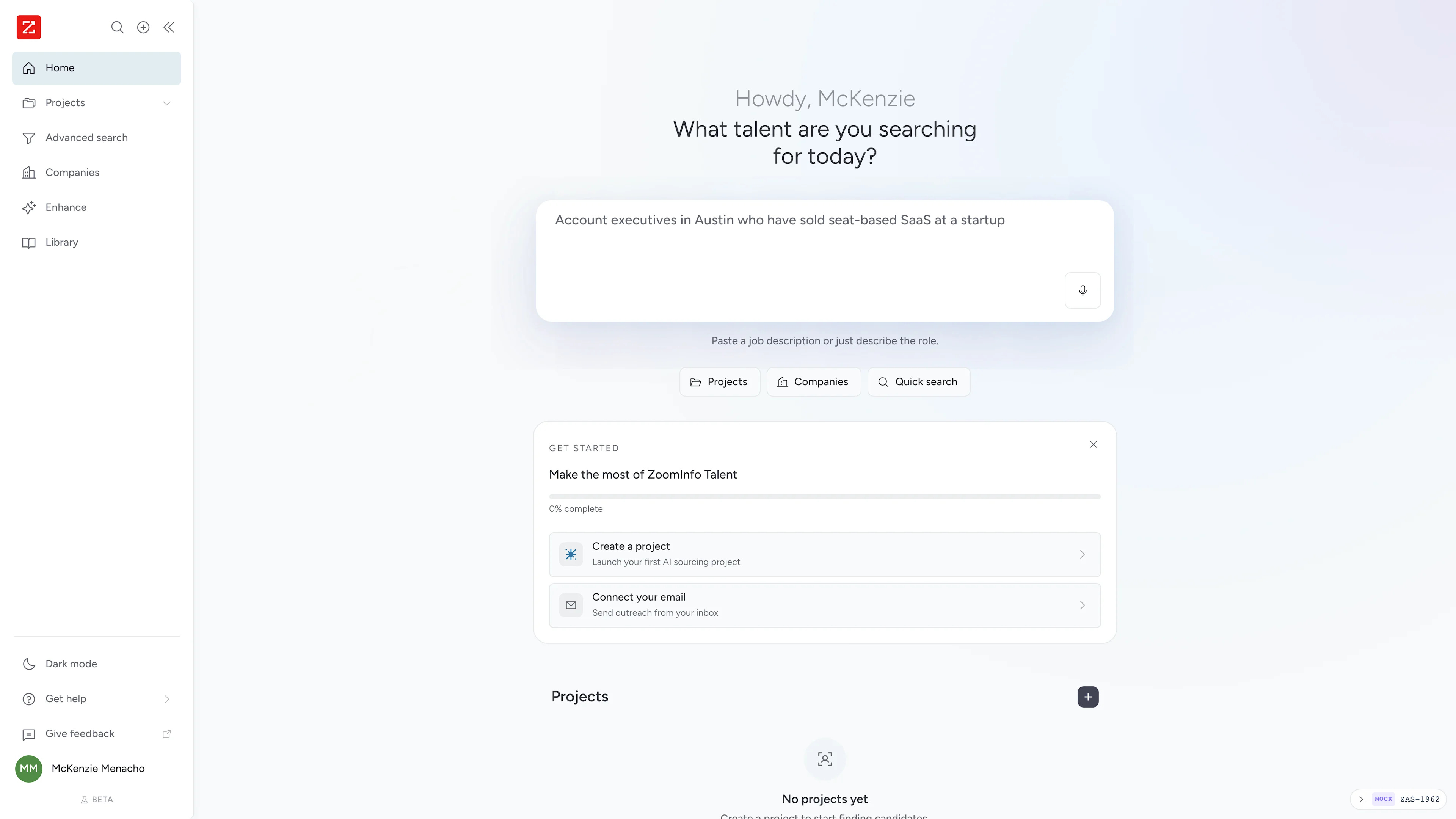
Beta customers ZoomInfo quoted in its own materials back that up. One construction-industry customer said trying it against LinkedIn side by side was “night and day” on candidate quality.
The consumption question that has plagued every SaaS company came up in the analyst briefing, too. When ZoomInfo priced Talent Autopilot on a per-job, capped-block model, HR-tech analyst Rebecca Wettemann of Valoir pushed back on calling it “consumption-based” at all, warning the word spooks buyers who spent the last year watching AI token bills rocket higher and higher.
I am less concerned about that, though. Recruiters have been paying for consumption forever. More jobs = more spend. But recruiters are also used to more granular controls and caps. It seems like they’ve listened to their buyer here.
ZoomInfo Just Had a Very Bad Spring
ZoomInfo cut its own 2026 revenue guidance earlier this year, from $1.247 billion-$1.267 billion down to $1.185 billion-$1.205 billion. CEO Henry Schuck told investors the company saw “a trend of AI and agentic confusion” in customer conversations that spring, one that paused purchasing decisions industry-wide. The stock dropped 32.78% the next day, from $6.04 a share to $4.06.
A class action, Tejeda v. ZoomInfo Technologies, is now working through federal court in Seattle over whether the company misled investors about how its AI products were resonating with customers.
Today, GTM trades around $3.88, down from a 52-week high of $12.31, according to real-time data from S&P Global. Its market cap is down about 70% over the past year. Even the average analyst price target, $4.60, sits above where the stock trades now.
Wall Street already thinks it’s underpriced, but buyers are still waiting for something long term to get excited about.
A launch like this might buy the company something else: proof to Wall Street that its AI story runs deeper than one bad quarter. But it’s still asking recruiters to trust a new AI agent with it’s nearly two-decade lead in data.
Delivering Results Is the Only Proof Left
In my view, the idea behind Talent Autopilot is sound. If you’ve hired anyone in the last five years, you’ve been burned by data that was out of date, incomplete, or stretched the truth because it was self-reported.
Verified, current, searchable data fixes a real problem.Whether it works is a different question.
ZoomInfo can only answer it by delivering a product that delivers on talent acquisition’s real pain points, not just presenting slides about it. The company has spent the year proving AI claims and customer experience don’t always match.
Now it’s betting its next product on the opposite being true.
We’ll know soon enough, the same way everyone else will: whether the candidates it finds are ones your team actually wants to hire.
ZoomInfo’s headquarters sits along one of my favorite walking routes in Vancouver. I’m selfishly rooting for them, because when ZoomInfo does well, my city is better. I like our city having jobs that aren’t based in Portland.
But I still want the receipts. My guess is we’ll see them soon enough.