


A long, long time ago when I was still in HR, I watched two managers face the same crisis in different ways. Business was down, we had to shift people, and employees in the organization were frustrated and scared.
One gathered his team in a conference room the morning the news was going to be announced. He didn’t have all the answers, but he told them what he knew, admitted what he didn’t, and promised to keep them updated.
The other manager waited for the official talking points. When they came, he sent them via e-mail. By the time they got the sterile news, the team had already heard from their colleagues that change was coming.
A month later, both teams had the same leaders and a similar group of employees as they had before but very different levels of trust and performance.
Back then, all I had was vibes for what I saw. Clearly, the first manager was operationally better and a more empathetic leader. You could see signs of it in his employees too. But why did it seem like his team also buckled down more and were more willing to put in the unpleasant work to turn our fortunes around?
If the story is familiar, it’s because this pattern plays out everywhere. And now, SparkEffect (formerly Waldron and Torchiana)’s 2025 Trust in Turbulence report puts numbers to what many of us have seen up close: Trust is an operational variable that can predict whether teams hold together or fall apart when things get messy.
The numbers tell a simple story
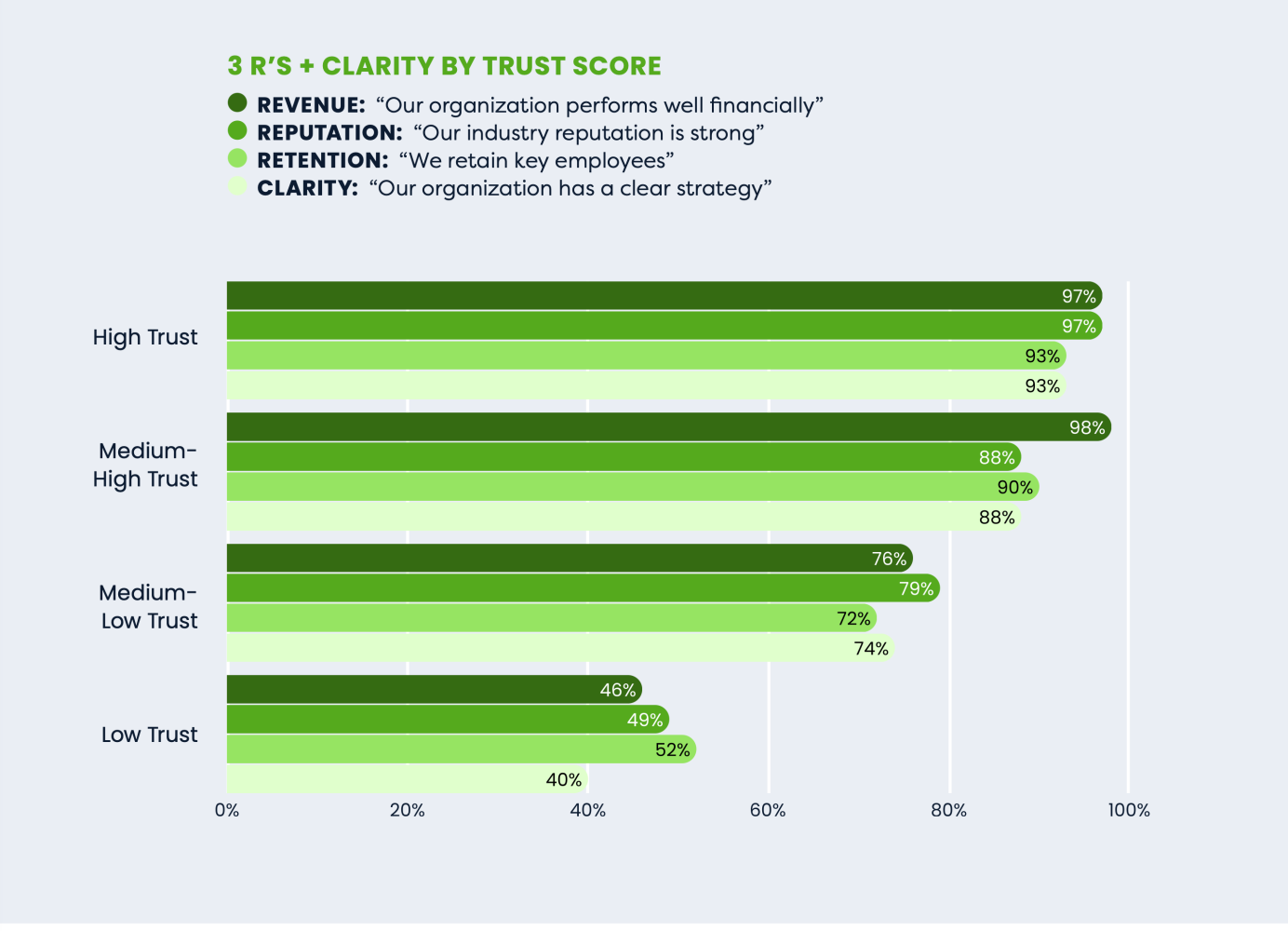
When employees trust their leaders, everything works better. The key findings from the report shows that in high-trust organizations, 97% of people say their organization has strong financial performance. In low-trust environments, it’s less than half. Retention jumps from 52% to 93%. Even basic clarity about the company’s direction doubles.
Trust comes from how leaders show up every day. It manifests in how they explain decisions, handle uncertainty, and follow through when it matters. During disruption, those daily actions decide whether a team holds together or falls apart.
Where trust actually lives
The data also answers a harder question: who holds that trust?
It might surprise you that it isn’t the CEO or the executive team. Having worked with executives, I know big decisions that rock companies feel like a pressure cooker for them personally. They feel like everything they do is under a microscope.
But trust is really owned by the managers who talk to employees every day. People place far more confidence in their direct leaders than in “the organization.” But that confidence is brittle. When disruption hits, trust in their direct managers is what drops sharply. Their trust in the broad organization? It barely moves.
That should make every executive pause and consider where the pressure truly resides. The moment turbulence hits, the leaders closest to the work absorb the shock first. They become translators and stabilizers, all while trying to keep the work moving as if nothing was happening. If those leaders don’t have clear direction or support, the trust gap starts there and spreads fast.
The research makes a point that’s easy to overlook: leadership across the entire organization is strategic infrastructure. It’s as essential as having an office roof that doesn’t leak or a warehouse that has been upgraded to modern safety standards. You can’t build trust through slogans or one-off initiatives. You build it from the ground up by equipping managers to lead with clarity, fairness, and empathy. That’s especially true when they don’t have all the answers.
And when disruption happens, scaling your leadership capability is the only way to keep the value of trust intact.
When the waves hit
Every leader hits a moment when the room goes quiet. A tough call, a bad quarter, a change that lands wrong...
Values set the next move. They shape the words you choose, the tradeoffs you accept, and the people you protect. They decide who hears first, who gets context, and who gets your time.
Comfort tempts shortcuts. Values hold the line. They ask for plain talk when news stings. They demand fair process when speed feels easier. They keep promises in view when pressure shows up.
People watch the choices that their direct managers make. They see who they stand with, how they explain it, and whether they stay present when the room gets heavy. Those signals become the story employees tell about working there.
The teams that came out stronger shared four habits, and none of them are complicated:
They communicate early and plainly, even when the news is rough
They explain the “why,” not just the “what”
They treat people with fairness and empathy in the moment
They invite questions, even when they can’t answer all of them
Those actions sound basic, but they’re show up rarely under pressure. The report found that when disruptions were handled well, employee trust actually rose above baseline. When they were handled poorly, trust dropped by nearly 30%.
The elasticity of trust
SparkEffect uses the term “elasticity” to describe how well trust stretches under pressure and snaps back afterward. I love it. The idea is simple: some organizations absorb the hit, learn from it, and emerge steadier. Others crack.
In high-elasticity environments, employees say their companies retained key people, sustained reputation, and had a clear plan for the next challenge. In low-elasticity ones, those same scores collapse. Strategy clarity, arguably the foundation of leadership,bottoms out almost completely.
That’s what happens when trust runs out.
Most crisis plans focus on risk management: minimize damage, restore order, move on. The better leaders treat disruption as an accountability moment. They use it to show who they are when things aren’t easy. When handled with transparency and care, those moments turn into proof points of integrity.
Building trust on purpose
Trust can’t be built with values statements or an executive leadership retreat on purpose. It’s much more pragmatic than that. The research suggests four practical moves every organization can make to meaningfully support trust:
Support your frontline managers. They hold the most trust and the most risk when things go wrong. Equip them. Have them build a bank of trust when those hard moments hit.
Rehearse crisis leadership before you need it. Practice clarity and fairness in small moments so they’re automatic in big ones. These moment count and become evidence for or against your leaders.
Design fairness into decisions. Ask early: Is this clear? Is this fair? If I described what I did to an outsider, would they get it? If there’s hesitation, there’s work to be done.
Measure trust like you measure performance. What gets measured changes behavior.
Trust shapes the outcome of every disruption, from how people talk about leadership to whether they stay to help fix what broke.
What endures
Trust grows in the moments that test conviction. It takes shape through clarity, fairness, and steadiness when conditions shift. Each disruption becomes a record of what leaders chose to stand for.
Leaders who ground every decision in those values leave something lasting: a pattern people can rely on when change comes again. That consistency is the foundation of endurance, the quiet strength that carries a company forward.
That’s it for this week!