


Back in 2022, Qualtrics launched something called CrossXM and I wrote a column asking a pretty basic question: How much do you actually have to spend on employee experience before it shows up in customer experience?
I used my local dive bar as the example. Great customer experience, no fancy CX tools, and they didn’t even take credit cards until a few years before that. I still think that’s a fair question, and I still don’t know the answer.
Four years later, Qualtrics built something bigger around the same question. I’m not sure they answered it yet, either.
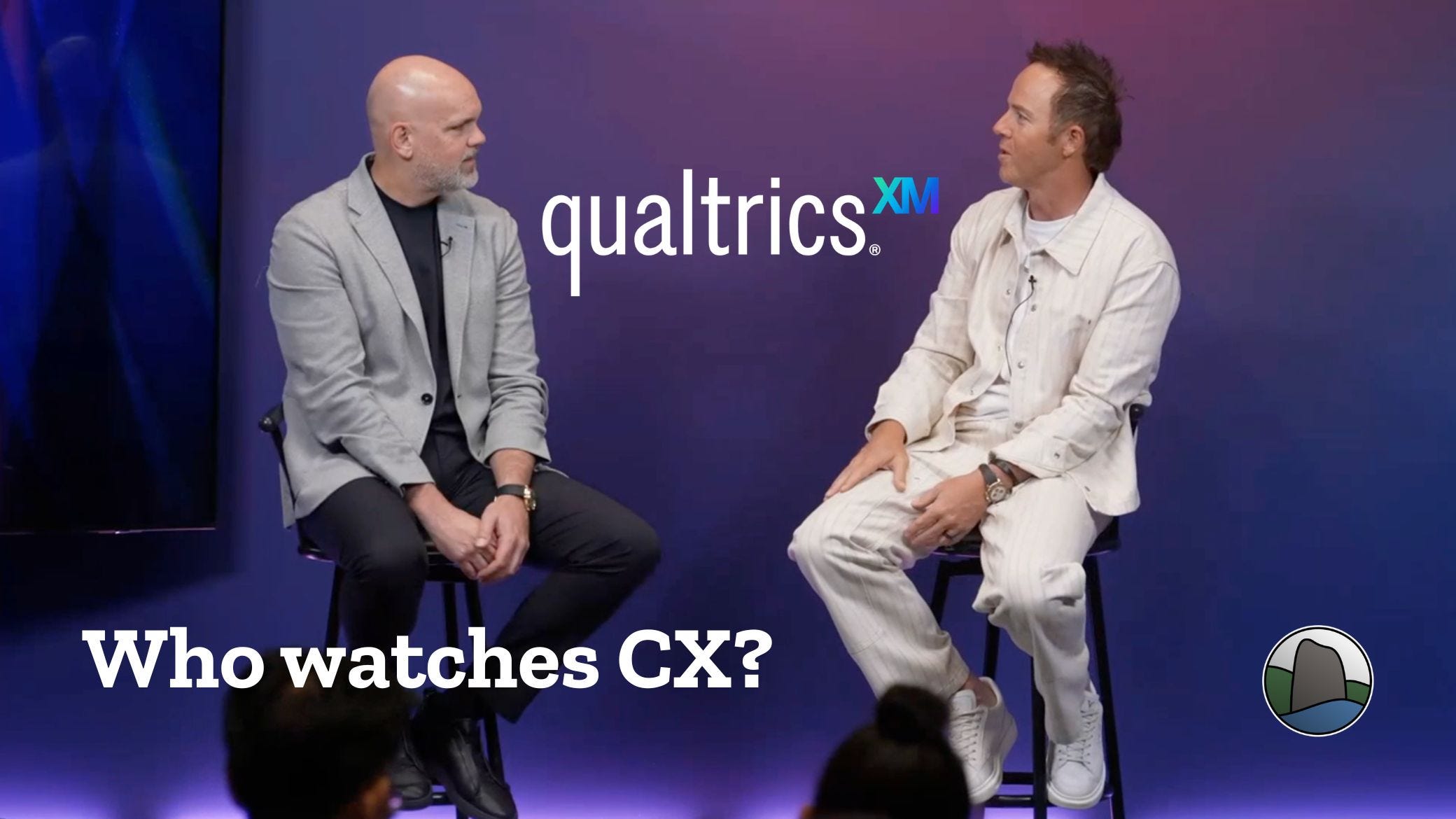
Yesterday the company held a stream out of Ryan Smith's training facility in Salt Lake City to announce XM Data & AI. Qualtrics builds fake customers to stand in for real ones. It guesses what one specific customer does next. Then an AI agent writes that action straight into whatever system holds it: a loyalty program, a booking tool, or whatever else is plugged in. Qualtrics' names for that: Simulate, Predict, Trusted Outcomes.
That’s the pitch, anyway.
Qualtrics CEO Jason Maynard says the word EX out loud once, which was loud enough for me. But his line, or any other mention of EX, never makes it into the press release, or into any of the three writeups I found.
What’s actually for sale today: a consulting package (an X-Loop Diagnostic that maps what Qualtrics calls experience loops) and a bundle of reputation tools.
The stuff that actually looks like employee experience work, an app that routes a task to whichever worker’s up next, a prompt on someone’s screen mid-shift, comes out in 2027. So does the agent writing that action into somebody else’s system.
Qualtrics already updated its own EX suite this year, back in March at X4. It offered AI that asks a sharper follow-up question on a survey, plus attrition flags built by mixing HR records with survey answers. Group-level stuff, across a whole team. Nothing here guesses at one employee the way Predict works on one customer. Qualtrics’s own support page still limits synthetic panels to US general-population consumers.
I find the money more interesting than the roadmap, honestly.
In May, Qualtrics closed a $6.75 billion deal to buy Press Ganey Forsta, forty years of healthcare data across more than 41,000 facilities. That’s patient data. Squarely the customer side.
And Medallia, the closest thing EX has to its own heavyweight, got a fresh $150 million from a Blackstone-led group in June, a markdown five years after Thoma Bravo bought it for $6.4 billion. Culture Amp cut 70 people that same June, about 9% of its staff, its third round of cuts in three years.
Not a great year to be an EX-only vendor, if you’re keeping score.
So just look at where the money’s actually going. It’s flowing to the side that touches customers directly. Employee data just rides along, picked up as whatever the CX product happens to need to see about the person doing the work, and the CX budget picks up the tab.
But none of it works without somebody actually doing the job in front of the customer, though. A model can guess what a guest wants. It still takes a person to hand over the free upgrade, eat the complaint, or smooth over the delay.
Who’s watching whether that interaction actually goes well? An employee is. It’s the one who gets the prompt on their screen mid-shift, in the same demo where Maynard says the word EX, the only time all day.
That’s EX.
The one thing missing from the whole pitch. Same question I had in 2022, just with better production values this time.