


One of my persistent annoyances in my never-ending quest to understand what is going on in the world of work is how fragmented all of the publicly available information is to access. We have some seriously great data resources and they are all available in different ways on 15,000 different websites.
Okay, that’s a slight exaggeration.
One of the first things I built with Claude Code was a way to access all of this information in a single view. With API access for nearly all of the data, it was pretty easy. I got a little dashboard that lived on my computer that I could browse and search in one place.
Then I wanted to chat with my data. First, I added in a chat into the dashboard. As I learned about MCP servers, I thought it would be better to just be able to chat with the data. So I built that too.
Then I simply used it. It has helped me grab numbers for research, columns, and reporting.
I told a few people about it and they encouraged me to share it. So, with the help of Claude’s Fable, I improved the portability and interface some while adding a few latent features that I was just using workarounds for.
So, today I am launching my first research tool: Workforce Data Explorer (killer name, right?).
What is it and how can you use it?
Workforce Data Explorer is an open source tool for understanding the U.S. labor market.
U.S. labor data lives across a dozen agencies and sites, each with its own interface, format, and limitations. This puts it behind one interface:
89 curated sources, searchable by topic, geography, and update frequency
30 data sources connected to live APIs - the tool fetches current numbers on demand, not links to somewhere else
Two kinds of data, deliberately mixed:
Official statistics
Faster signals from other open sources
There are three ways you can get access to it:
1. The dashboard — zero setup

You can access a live dashboard here: workforce-data-explorer.streamlit.app. This is the easiest way to see what it actually looks like and how it works.
It opens on a live overview: unemployment rate, monthly payroll change, job openings, and weekly UI claims, each with a two-year sparkline. From there, ten pages:
FRED Time Series — a front end to the Fed’s 816,000-series database: 70+ curated labor topics (quits rate, wage growth, participation by demographic) plus free-text search of the whole thing
BLS Series — jobs-report series, JOLTS, Employment Cost Index, productivity; enter any SOC code and get that occupation’s mean wages and employment
State Labor Markets — pick a state, get its four headline indicators on one screen: unemployment, payrolls, weekly claims, JOLTS openings and quits
Census — three tabs:
ACS demographics (employment, income, commuting, remote work) by state or county
Quarterly Workforce Indicators — hires, separations, earnings over time
County Business Patterns — employment by industry sector
O*NET Occupations — profiles of 900+ occupations: skills, daily tasks, abilities, technology used — plus an “AI usage by occupation” view showing how much of each job’s real task list appears in actual AI usage. Measured behavior, not predictions.
DOL Enforcement — weekly UI claims, OSHA inspections searchable by state and date, wage-and-hour cases with back wages assessed
SEC Filings — full-text EDGAR search: layoff 8-Ks with company names and links to the filings, human-capital disclosures from 10-Ks, any company’s filings by name
Job Postings — Indeed Hiring Lab’s daily indexes, the timeliest public read on labor demand that exists:
National trend, all 50 states ranked, 41 occupational sectors ranked
Any metro area over 500k population
The share of postings mentioning AI, tracked over time
Everything indexed to Feb 2020, so every number is a plain “vs. pre-pandemic” comparison
Catalog — the searchable index of all 89 sources
AI Assistant — ask in plain English (”show me quits vs. openings since 2022”), it fetches and charts the data. Rate-limited on the shared instance; unlimited with your own free key though it is slower than your typical chatbot.
2. Plug it into your existing AI
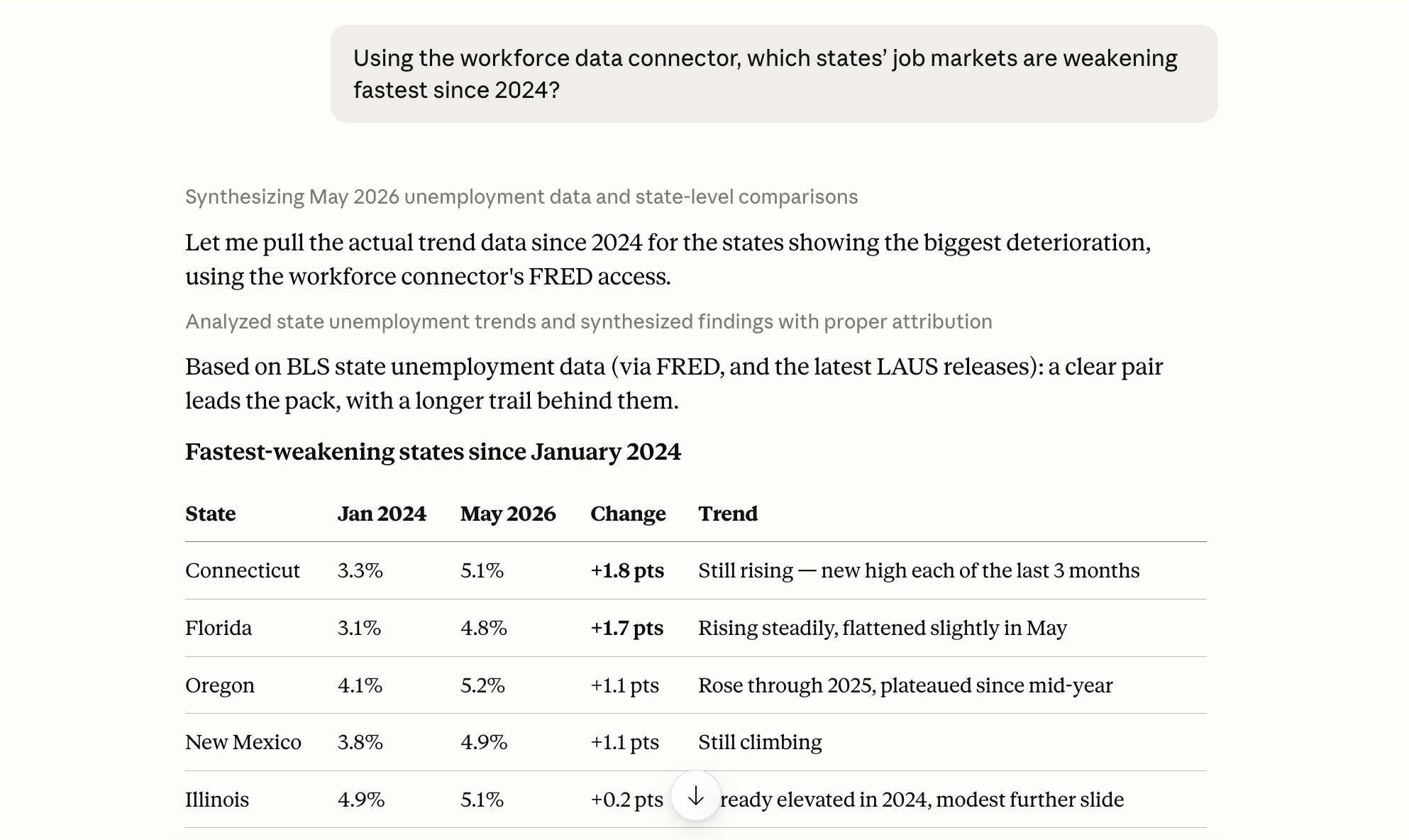
If you want to chat with the data and you already have an LLM that has MCP capabilities, this is the best way.
Setup is one URL (updated!): https://workforcemcp.beaconturn.com/mcp
Claude: Settings → Connectors → paste the URL (paid plans)
ChatGPT: Settings → Connectors, developer mode → same URL
Your AI gains 15 tools it calls live while answering you:
FRED and BLS time series, with search
Job postings rankings by state, sector, or metro
AI share of postings
Full state labor-market snapshots
Occupation wages and O*NET profiles
AI-usage exposure for any job title
Weekly UI claims
Layoff filings and company filings from EDGAR
The source catalog itself
Ask is a workforce data question and it pulls the actual claims and postings numbers from live data that is accessed via a very efficient API poll rather than letting your LLM roam freely on the internet.
3. Run it yourself

Clone the repo on Github and the whole stack is yours:
The dashboard, the MCP server, and the data layer underneath
Grab your own free API keys, ~5 minutes of signups, all listed in the README
Deploy configs included for hosting your own copies of both the dashboard and the connector
A one-click desktop extension (.mcpb) that connects the local MCP server to Claude Desktop with no config-file editing
The connectors are plain Python modules with no framework lock-in
The whole thing is MIT Licensed, which means you can fork it and generally do you what you want with as long as the license text is included in your work.
Find a something wrong? Open an issue on GitHub, with quick templates for bugs, data problems, and source suggestions. Or you can hit me up if you think I am missing anything else that should be included.
What else is happening this week?
Your AI Is Hiring Too Many Bad Employees. The real argument isn’t about tokens, it’s that companies stuff AI prompts with the same junk they used to stuff into meetings. Cut both, says Jason Averbook.
The How #28 - July 16, 2026. Katie Achille watched someone she knows get swallowed by a viral news cycle and turned it into a case for treating your media diet like mutual aid. Stop feeding stories that aren’t yours to feed.
The $21 Billion Company Behind Eventbrite, Vimeo, and AOL Has Just Revealed How It Picked 286 Out of 800,000 Job Applications. Bending Spoons hired 0.04% of 800,000 applicants last year, and treats it like a brag, not a crisis. They’re right that interviews barely predict who’s good at the job, though.
Meta’s AI-Based Layoffs Allegedly Targeted Workers Who Had Taken Protected Leave. Twenty-six Meta employees say the layoff algorithm scored them on metrics you can’t rack up while on medical or pregnancy leave. Meta says people made the calls, not AI, an odd claim about a system built for exactly that.
The U.S. Labor Market May Soon Face a New Crisis: Too Few Workers. Pick a panic: AI eliminates half the jobs, or boomers retire faster than anyone replaces them and employers spend the 2030s begging for workers. Door two comes with real wage leverage for the young workers who stick around, according to demographer Steven Ruggles.
Starbucks Says Coffee Is For Vibe Coders. Steve Smith flags the true story in Starbucks’ $400 million software budget: it’s vibe-coding its own inventory and maintenance systems instead of paying Microsoft and IBM. When your biggest customers can just build it themselves, every enterprise vendor’s pricing model gets shakier.
There Are No Dumb Questions (But There Are Some Very Expensive Ones). The question that nearly tanked Jason Seiden‘s first job wasn’t dumb, just too honest: he asked his CEO to prioritize his workload and got told to figure it out himself. Every question you ask reveals how much you understand about the room you’re in.
Indeed Is Walking a Fine Line on the Fine Print. Indeed’s new terms insist it’s not, and never will be, anyone’s legal agent, a move aimed straight at the Workday and Eightfold discrimination suits. Two bullet points later it launched a bot that applies to jobs for you and bills the employer per application, a contradiction Mike Wood catches immediately.
The Middle Miles: What Nobody Tells You About Month Seven. Brian Fink is seven months into grieving his father and argues American bereavement policy gets the shape of grief backwards. Three days of PTO assumes the danger is the raw first weeks, when it’s actually the smooth, forgettable middle.
Study Finds Fair Workweek Laws Improve Schedule Predictability. Requiring two weeks’ notice and banning clopening shifts actually gives retail workers more predictable schedules, and Harvard’s Daniel Schneider found no evidence employers clawed the cost back in lower wages. Enforcement is incredibly important: New York City’s aggressive follow-through got a 25-point jump, Philadelphia’s got five.
Workforce Atlases. Eleven states already have more retirees than kids waiting to replace them, and Utah is the only one still shaped like an actual population pyramid. It’s a genuinely useful map of where AI’s impact lands hardest, built by John Sumser.
Humanity in AI Awards. Nominations close July 24 for MeBeBot’s award honoring HR and IT leaders who deploy AI without treating employees as collateral damage. Three winners get $500 and a badge, a modest prize for what should be the baseline.
Deel Moves to Strike ‘Spy’ Witness in Rippling Lawsuit. Deel wants a judge to toss the core claims in Rippling’s lawsuit because the witness who says Deel paid him to spy won’t testify anymore. Rippling calls it a Hail Mary, and this is the rare corporate suit that deserves to actually go to trial for entertainment purposes.
Celebrating 75 Years of Shaker. Joe Shaker Jr marked 75 years of his family’s recruitment marketing company, a rare milestone in an industry this consolidated. Congrats to the whole team on staying independent this long.
HC Insider: July 2026. This new monthly Deloitte roundup, from Kyle Forrest, opens with a stat: 84% of organizations grew AI access without redesigning a single job around it. Adoption and adaptation aren’t the same thing.
ERE Recruiting Innovation Summit Agenda. The November lineup is stacked with talent acquisition leaders from Ford, Wells Fargo, CVS Health, and Expedia. Nice job David Manaster and team.
Energage and Engagedly Join Forces to Accelerate the Future of Talent Management and Workplace Experience. Two of the most confusable names in HR tech just solved the problem by becoming one company. Now there’s only one name to get wrong.
BI Worldwide Buys WorkTango to Reach Mid-Market With AI Survey Tools. WorkTango keeps its name and team, but the real prize for BI Worldwide is a mid-market foothold it would’ve taken years to build, as board chair Gary Hansen made explicit.
Why We’re Building the Harness, Not Another Agent. Rob Catalano‘s next act after WorkTango bets GTM teams need what developers already got: not a smarter agent, but the scaffolding underneath it. Gartner expects 40% of agentic AI projects to get cancelled by 2027, and his argument is that this is exactly why.
Have a great rest of the week!