


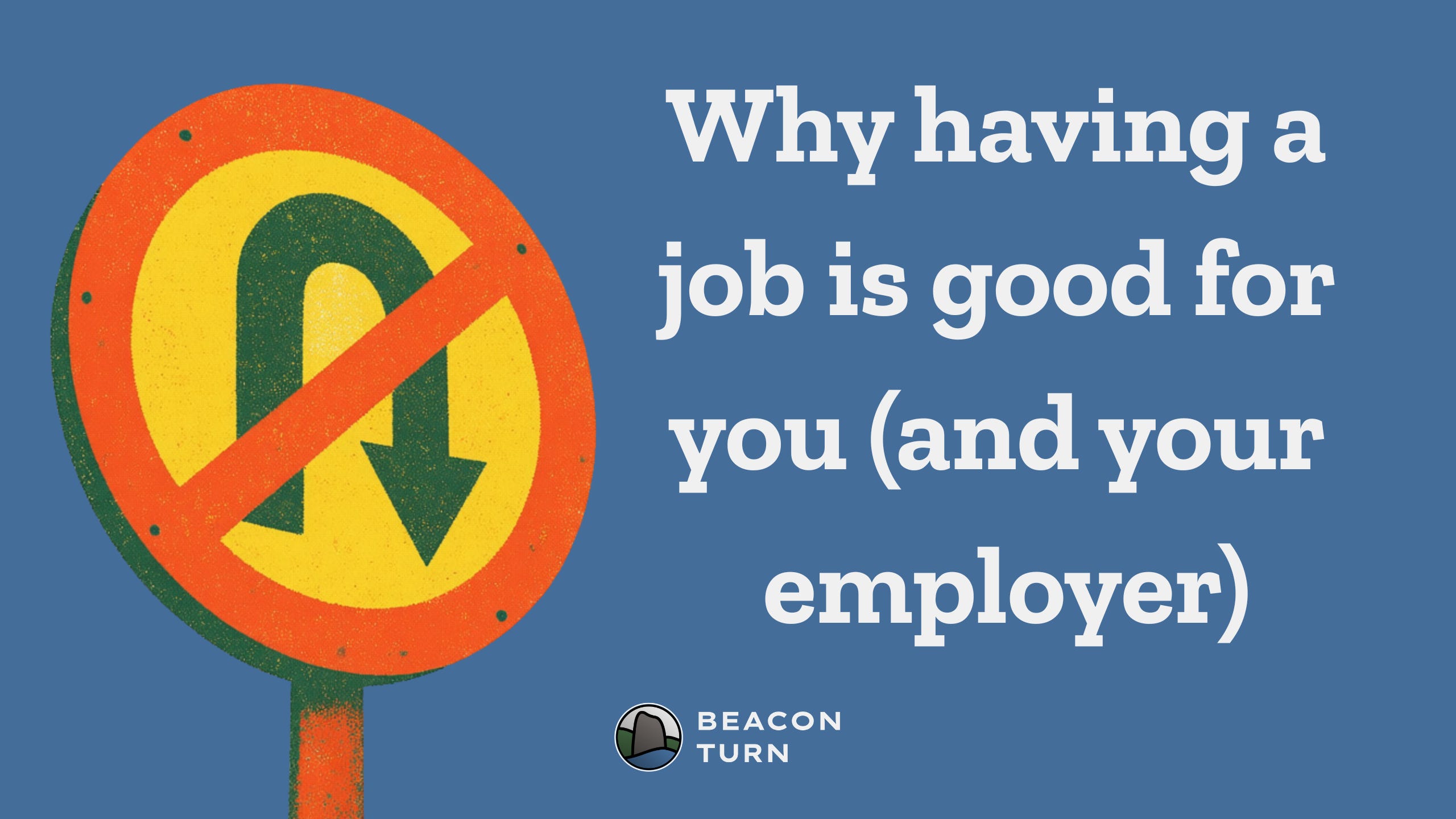
“The employer-employee relationship is broken.”
In a trip through my inbox over the past 15 years, I have seen countless pitches that told me exactly this. Employees and employers have no sense of collective loyalty anymore. Engagement continues to tank. Longevity at companies is a rarity. Hiring is tougher than just finding the skill set you need.
After seeing coworkers get laid off with no notice, little severance, and thrown out into a brutal job landscape, it’s understandable that people might think to just say no to a new job in general. “I’ll just contract for awhile.”
After seeing employees leave with little notice and switch allegiances to a competitor, it’s understandable to that organizations might think twice about employing another person who can just leave. “We’ll just contract this role for awhile.”
I’ve been told for a long time that this shift is inevitable. That AI might accelerate it. That it might be healthier for our psyche if we disconnected our identity from our work.
And I nodded along. It makes sense in a sort of “no shit” way.
Employment is risky for employers. There are a lot of rules. There are liabilities and taxes. And even if you look past that, even a less ideal hire can really hurt an organization.
And employment isn’t always that great for employees either. Getting a job is usually a pain. With minimal protections for U.S. workers compared to much of the first-world, it can feel like contracting is just taking out the middle man.
But after nearly half a year of solopreneurship, I don’t think that argument hits as neatly as before. Which is a weird way to say that after leaving a steady paycheck, I believe the value of a good employer-employee relationship is severely underrated by too many people on both the employer and employee side of the equation.
I’m not playing Devil’s advocate here. I wrote a whole researched piece about it in Reworked last week.
Having a job is valuable. Having employees is valuable. In a good relationship, both parties do better together than they do separately. I’d say that in most instances, having a job is better for most people and that having employees is better than just simply relying on gig workers.
The why comes down to continuity and judgment. Employees anticipate and judge better when they’re at a job for a longer time. You know how things run. You know expectations. This is good for us and our mental wellbeing.
And those things are really good for employers too, even if they don’t always recognize it.
That doesn’t mean that jobs are perfect or that our reaction to disassociate from them because they are hot piles of garbage isn’t a natural response. So I also shared some ideas that would make them better, like better protections for workers and rethinking management practices.
But there were two things I didn’t write about.
One is that it’s really easy to take a good job and a good employee for granted. That’s not a flaw in the system but proof that a good employment relationship can be so good, it just feels like it will never end.
Two is that regardless of how you feel about employment, we have to do something to fix running solo if that’s what you choose. Taxes and regulations for the self-employed are onerous. Benefits are ridiculous. The lack of stability and certainty can wear on you.
In any case, give it a read and let me know if you agree or disagree.
I’m on Up Next @ Work
A few weeks ago, I recorded a podcast with HR tech legend Jeanne Achille to talk about the current version of the weird world of work and technology. We also talk about jobs might look like in a few years when my kid is old enough to decide what she wants to do.
Also, a note: If you want to bring me onto your podcast, just promise me we can talk about basketball for about two minutes and I’ll be good. You can even cut it from the show.
What else is happening this week?
US Jobless Claims Tumble to a Decades-Low 187,000 as Layoffs Stay Historically Low. Claims haven’t been this low since 1969, which reads great until you notice employers added just 57,000 jobs in June and the unemployment rate fell mostly because people stopped looking for work. A job market nobody is leaving and nobody is entering isn’t the same thing as a healthy one.
Stop Managing Machines Like People. Stop Managing People Like Machines. Chris Havrilla launches a new Substack and a new venture with the argument that we spent thirty years measuring human output instead of outcomes and are about to do the exact same thing to agents.
50 HR Tech Demos and Some Tough Love for Founders. After sitting through roughly 50 demos, Anita Lettink tells founders that the problem that annoyed them at their old job is probably not a strategic priority for anyone else. Her warning about chasing enterprise logos before you have revenue is a good one too.
The State of Candidate Fraud Detection & Prevention. A North Korean operative passed every video interview at KnowBe4, a company that sells deception training, and got caught by endpoint security on day one. The rest of the data on where fraud defenses cluster versus where fraud actually succeeds comes from Kyle Lagunas.
Resume Fraud Is Real. John Sumser points out that many of the fraud numbers everyone repeats lump title embellishment in with deepfake interviews, and that the vendors publishing those numbers often sell fraud detection. So, yes, it exists but buyer beware.
The Best HR & People Analytics Articles of July 2026. BCG’s finding that the capabilities executives value most are exactly the ones AI erodes fastest would be worth the click on its own. It is one of about fifteen things worth reading in the July roundup from David Green.
What You Choose to Interrupt. Seven pieces in, Jess Von Bank ends the Human Thesis series on a clear point: most companies are automating dysfunction they never bothered to fix. Capable technology in a broken operating model just gets you to the wrong answer faster.
He’d Already Lost Before He Started: What Zuckerberg Got Wrong on AI Agents. Stacey Harris reads Meta’s stalled agent progress as an org design problem, because it ran as an IT project and skipped the context and auditing work HR would have insisted on. Her data backs it up: only 4% of organizations are running full HR agents, and the early movers mostly sped up bad processes.
Closing the AI Hype Gap. The most AI-exposed workers saw a smaller unemployment increase than the least exposed between 2022 and 2025, and Goldman puts AI-related job losses at 2.5% of US employees. Gary Hamel and Michele Zanini line the evidence up against the three biggest claims, and it certainly beats the hype.
Only 30% of Americans Are Working in the Middle of the Workday. More than half of Americans are on leisure or sports by 8pm, and the middle of the workday is a lot emptier than any return-to-office policy assumes. The American Time Use Survey chart shared by Todd Nicolini deserves a long look.
Netflix Executive Says Sharing Mental Health Struggles at a Leadership Retreat Led to His Firing. A Netflix VP says he disclosed physician-supervised ketamine therapy for depression during a “Vulnerability-Trust” exercise at a company retreat, got investigated two months later, and was fired in April. These exercises were always cringe, and now there is a lawsuit testing whether anything you say in one is protected at all.
Trump’s Rollback of DEI Is Transforming Who Runs America’s Biggest Companies, Study Finds. Women and racial minorities made up 40% of new S&P 500 director appointments over the past year, down from 72% in 2021 and the lowest share since 2014. Boards are backfilling with sitting and former CEOs, a pool that is less diverse by definition, so the 49.3% of seats currently held is a lagging number.
The Front End of Hiring Is Where Adjacent Talent Is Won or Lost. Master Burnett argues in part two of his talent discovery series that AI can’t find adjacent talent because most organizations never defined the work in the first place, they just recycled a job description. A better model will not fix a bad intake conversation.
What Oregon Winery Leaders Taught an I-O Psychologist About Complexity. Agriculture, heavy regulation, public-facing branding, and multi-year paths to value all sit inside one operating problem in the wine business. Gabby Burlacu moderated the panel, and the takeaway is that tech is not nearly as complicated as it thinks it is.
All In Before the Flop. OpenAI and Anthropic now have to IPO near a trillion dollars or read as failures, which is a strange bar for companies still proving out their business models. Everyone pushed their chips in before seeing the flop, and as Andrew Hilger notes, it’s usually the player who switched to water hours ago who takes the pot.
Everyone Is Back in School Now. Jason Averbook points at the PNAS study where students using ChatGPT scored 48% better with it and 17% worse without it afterward, then asks what happens when you cut the analyst program to pay for the tools. Productivity borrowed from next year’s capability isn’t real productivity.
EEOC Gets One Step Closer to Eliminating Equal Employment Opportunity Data. The commission voted to repeal 60 years of EEO-1 demographic reporting on the theory that collecting the data without a discrimination complaint attached is itself the problem. Employers still have to collect it under Title VII, they just lose the early warning that told them where their exposure was.
When a Founder’s Opportunity Fund Win Ends in a 50-Page RICO Suit. Win the competition, get summoned to an eight-hour twelve-on-one interrogation, watch the valuation get cut, then get threatened on Christmas Eve. Kristy McCann walks through the whole loan-to-own playbook on the Chad & Cheese Podcast and somehow makes it oddly funny.
Talent vs. Tokens? It’s About Bench, Not Cost. Junior analysts were never hired for the deliverable, they were hired for the reps, and the zero-to-70% stretch where those reps live is the first thing an agent takes. That makes it a work design problem before it’s an AI problem, which is the whole argument from Steve Smith.
You’re Not Broken. The System Is. Twenty years of saying the things HR won’t say, and Laurie Ruettimann is now wondering out loud whether any of it worked. Meg Bear and Amy Wilson get her to the good stuff, including the case that financial freedom is what actually buys you the room to be honest at work.
America’s Layoff Safety Net Was Built for a Different Economy, and AI Is About to Break It. Bijal Shah makes the case that unemployment insurance, outplacement, and WIOA were all designed for downturns that eventually end. Only 18 states had adequate UI reserves in January 2025, down from 31 before the pandemic. That should concern anyone.
How “No Tax on Tips” Is Starting to Disrupt Frontline-First Companies and Workers. The tips exemption is now a $4.5 billion transfer that shows up, by Josh Bersin‘s math, as roughly 35% lower labor costs for companies that collect tips than for the ones that just pay wages. Target and Costco didn’t do anything wrong here, they just don’t have a tip line.
Segal Survey Projects Health Plan Cost Trend to Reach 15-Year Historic Highs. Medical trend is projected at 9.9% and prescription drugs at 11.5%, the highest in 15 years, driven by specialty drugs and GLP-1s. About a fifth of inpatient cost growth is attributed to AI-assisted coding intensity, which tells you what that technology is actually being used for.
Ford’s Rehire Wave Has HR Leaders Rethinking How AI Layoffs Get Decided. Ford rehired 350 veteran engineers after automated inspection missed defects experienced staff would have caught, and roughly three in ten employers have now run some version of that round trip.
Have a great rest of your week!