


Welcome back to a special edition of The Turn. We got all your usual and more. Wait, isn’t every edition special?
Well, today is my birthday. If you know me, it hasn’t been a big deal for me for a long time. My birthday agenda is usually:
Get my daughter to and from school
Work
Grab free beers from my favorite breweries within walking distance
Have dinner with family/friends (no more than a handful of people)
Watch some basketball
And honestly, that’s a pretty good regular day of the week outside of the the free beer part.
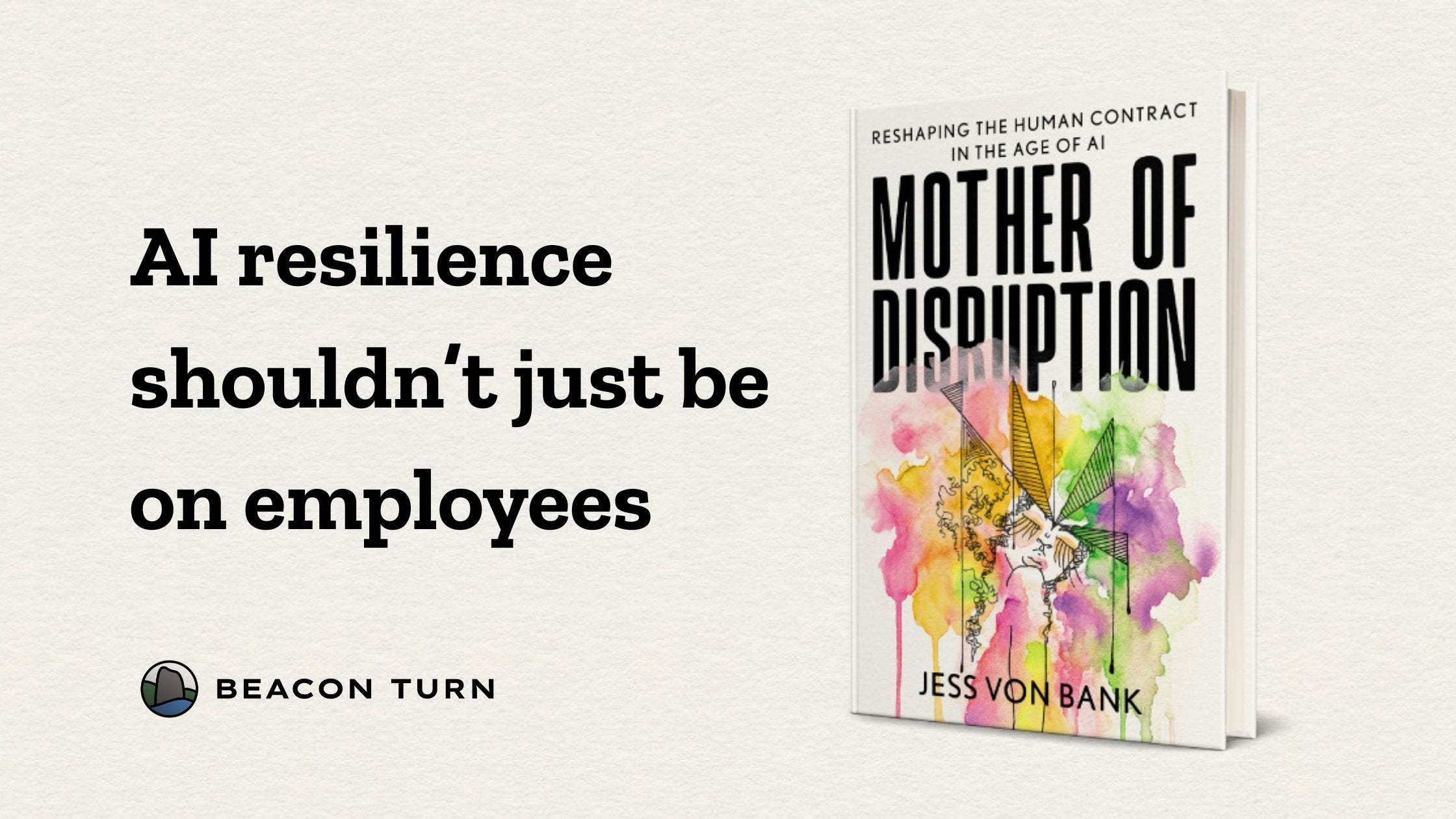
A bigger thing is happening today: Jess Von Bank | Now to Next’s Mother of Disruption is released into the wild. Instead of blasting out more news from HR Tech, I am going to tell you about this book.
In short: It’s really good. You should read it. And you should grab the ebook copy for $0.99 this week and give it a read.
I read through this book while I was in the throes of fall conference season and it did not disappoint.
Its central thesis is that the deal between companies and the people who work for them was already broken, and that AI made it impossible to ignore. Jess’s name for the pattern is system weight. Companies moved the cost of broken processes and constant change onto people’s nervous systems. AI accelerated the pain. Then they praised people for coping.
We let human bodies absorb the structural friction of broken designs, and then we called them ‘resilient.’
She names five wounds that folks suffer in this transition: fear of replacement, loss of mastery, decision fatigue, trust erosion and identity disruption. What companies typically read as resistance to AI is an injury, Jess says.
She tells the story of a postal carrier from her gym. The carrier delivered the birth announcements and graduation cards for a whole neighborhood and checked on older neighbors who lived alone. Then the postal service put the route on software that set the seconds allowed for each drop. The better the carrier got at the job, the longer and harder her optimized route became. She retired. The software removed a real part of the job that made a difference without anyone asking the people doing it.
The alternative she proposes is a covenant, and she defines it against what she calls a contract. It shouldn’t be, “I will buy your time, and you will carry my volatility.” In a covenant, the system is built to absorb that volatility so the people inside it don’t have to.
She says a real covenant is built for “the concrete floor, the delivery truck, and the clinic room.” In short, applicable everywhere. Her examples are a nurse with a right to override an automated care algorithm without being penalized for the variance, a delivery driver whose route budgets time for the porch visits, and a customer service rep whose queue adjusts after a bad AI recommendation upsets a customer.
Companies have for years recruited with “People are our greatest asset” and “We put humans at the center,” then run on “Maximizing Revenue per Employee” and “Strategic Workforce Optimization.” That’s not on AI.
Her example is ServiceNow CEO Bill McDermott on Bloomberg in July 2025. He said that the supporting cast of the soul-crushing work “is now being done by agents.” Agents also, he said, “work hard 24 by 7, you don’t have to pay ‘em, and they don’t need any lunch.”
Jess asked, “Wait, we had soul-crushing jobs? Who let that happen?”
Her theory for why the AI conversation is getting so much attention now is about status. Self-checkout at the supermarket took frontline jobs without a national debate, and it hurt people who had no platform to say so. AI is aimed at people whose careers rest on analysis and writing.
A kiosk replaces routine. AI brushes against the soul.
She revels in research. Stanford and BetterUp surveyed 1,150 U.S. desk workers in 2025, and 40% said they’d received workslop in the past month, about 1 hour and 56 minutes spent dealing with each one.
BCG and UC Riverside surveyed 1,488 U.S. workers and found that 14% of AI users reported “brain fry.” Leaders she talks to use Claude, Copilot or Gemini daily, many for more than a year, and still call themselves beginners. She reads that as a design problem.
In a September Substack post she wrote that companies have largely used AI while keeping the same business processes, which she compares to “hitting 1.5 on a podcast playback to listen to it faster.” I call it doing dumb things more efficiently than ever before.
The criticism of writing a book like this is that some of it will be out of date within a year. I don’t buy that. A good portion of this is just good operating language. The book still pins down what leaders were dealing with at the end of 2026. That’s helpful too.
In one of my favorite vignettes, Jess describes a board approving an AI roadmap with a line on slide twelve for headcount efficiencies over three years. The slide doesn’t say which roles, which people, or what anyone will tell them.
The room where AI investment is being justified does not contain the people who will live with the consequences.
She lists four things leaders skip: consent, timeline, who’s impacted, and repair. On timeline, she writes that leaders are “making generational decisions on a quarterly timeline.” The CEO who signed off may not be in the job in three years.
That seems bad.
Her list of where risk lands under the old model puts ethical gray zones on HR and legal and the change burden on “everyone except executives.”
I’d argue that, for the most part, the executives who approve a number like the one on slide twelve don’t pay for it if it goes badly, and the plan rarely names who owns what happens to the people in it.
Before deploying an AI tool, she says to watch the people who will use it work in their current screens for two hours, and to delay the rollout if their load is already maxed out. Instead of praising people for logging off at 6 p.m., she says to build the boundary into the routing logic so a task can’t be sent to someone who’s off duty.
Her larger constructs of what she calls the Reciprocal Enterprise doesn’t say who builds them but it’s worth diving into it. A book can’t assign owners. The book “does not ask you to agree with it,” she writes. It “asks you to do something with what you now see.”
If you’re in the room where a number like that gets approved, you can ask which roles are in it and who owns what happens to them.
MotherofDisruption.ai has the Amazon link where the ebook version for $0.99, and there’s a Goodreads giveaway of 100 Kindle copies for U.S. readers that closes tomorrow. Early Amazon reviews matter a lot to a launch, so if you read it, an honest one helps.
Go get a copy. I am buying a non-review copy too.
What else is going on this week?
Everything at HR Tech This Week Looked the Same. More about the sameness from The Meg & Amy Show, which says Meg Bear calls it a byproduct of AI-assisted copywriting and that it’s a message clarity problem while the products differ a lot.
TechWolf Remains a Wildly Weird and Wonderful HR & Work Tech Success Story. Great GTM lessons from Jonathan Goodman, who thinks out loud about TechWolf’s run from a Ghent University project to SAP’s agreement to acquire it.
What Happens in Vegas? Agents, Skeptics, and Casino Stink. I’ve spent a lot of time in Vegas with Steve Smith over the years, so heed his calls: he found deep skepticism at HR Tech about AI’s business value and governance.
Two Quick Reads That Will Make You Feel Better. I always trust Heather Bussing‘s book recs, and she says two new books, including Jess Von Bank‘s Mother of Disruption, helped her reframe a run of fury and grief.
Not It. Lack of accountability is a scourge, and Kristy McCann ties ten stories together around one move, a party writing a sentence that shifts risk onto someone else.
Impossible Standards Don’t Guarantee a Good Life. Kat Kibben traces feeling one decision from losing everything back to growing up under impossible standards, first their mother’s and then their own. A coach asking what would ever be enough started their shift, and knowing when something is done is hard.
The Wrap Takes an Epic Journey to HR Tech. Mike Wood reports back from two weeks in Las Vegas across Workday Rising and HR Tech on tools that watch workers and vendors building MCP connectors. He logged too much time out there for you to ignore this.
Why Prices Will Fall and Wages Will Rise: Enterprise AI Economics and Lessons from 1873. I love a good history reminder, and Josh Bersin sets the AI buildout against the railroad boom and the bust of 1873.
Ground Level at the 2026 HR Tech Conference: Three Things I Enjoyed, Three Things I Found Frustrating. I agree with Steve Hunt, who has attended HR Tech since it was in Chicago and liked the vendor floor and the colleagues but found the sales-pitch sessions frustrating.
Stop Outsourcing Your Future Self. Google is retiring its Custom Search JSON API on January 1, and Brian Fink uses that to argue that sourcing skills tied to a vendor’s tool are subscriptions. Seems applicable to a lot of my colleagues in marketing.
The Free Market of the Company Lunch Box. I have seen this too, and Robin Schooling turns the catered boxed lunch at an all hands into a negotiation over who ends up with the Doritos.
We All Want to Be Cyborgs Now. Do We Really? I Think Yes!. Jason Averbook recaps a podcast episode on three ways of working with AI, from handing it the whole task to blending your work into it. I’m not sure about this one, but it provoked some thoughts.
Who Actually Controls AI Recruiting? Human-in-the-Loop Is Not Enough?. Kevin Wheeler asks who controls AI recruiting when the reassurance is that a human makes the final hiring decision. All the research points to human in the loop being an incomplete solution.
Show Me the Hiring, Not the Brochure: HR Tech 2026, Days 1 and 2. Show me, show me, show me is Jackye Clayton‘s one question for every company at HR Tech, and after two days she says the brochures are excellent while the hiring is harder to find.
AI Didn’t Create a Leadership Gap. It Exposed It. Jennifer McClure cites a ManpowerGroup survey where only 3% of 80 senior leaders said their leaders are highly prepared to lead AI adoption. AI is the spotlight on that gap.
Who Can Afford Democracy?. Madison Butler writes that leaving work early to vote, having childcare and having transportation are privileges, and I’ve been thinking about this a lot too as we head toward another tough election.
Who Is Winning the AI Era: Findings from HR Tech 2026. Good insight from Charles Bedard, who read the HR Tech floor against 3,280 Work Tech deals and found that AI wins when it sells the outcome.
Your Employer Brand Reputation Isn’t Yours to Control Anymore. Bryan Chaney says candidates now learn about your company from AI search results, Reddit threads, Glassdoor reviews and TikToks from former employees. Brand has always been about what other people think and say about you.
Everything in HR Tech and Work Tech Is Starting to Look and Sound the Same. Great post from Sarah White about the sea of sameness, which she traces to a wave of first-time attendees and exhibitors and to thinner competitive and market intelligence support at established vendors after layoffs.
A Potentially Unpopular AI Opinion: Maybe We Need AI to Help Us Write Less. Not unpopular for me! Celinda Appleby says the problem with cold outreach is targeting, and suggests AI could help reach the people who make sense.
Introducing Kingside. Congrats to Jeff Petersen on formally introducing Kingside, which helps small businesses and startups implement AI.
HR Tech 2026 Pitchfest Winners. Hammock ($25,000), Orbio AI ($10,000) and DigaVouch ($5,000) won, so congrats to them!
Every Year on the Anniversary of My Brother’s Death, I Honor His Memory. I read this story every year, and Lars Schmidt shares it on the anniversary of his brother’s death to humanize addiction.
In the news
Sirius XM Wins Dismissal of AI Hiring Bias Lawsuit via HR Morning
Anthropic’s People Products Head on the Recruiter’s Evolving Role and How Claude Can Help via HR Executive
Pentagon Pilot Cuts Army Civilian Hiring Time From 161 Days to 47 via Federal News Network
Report: More Than 70% of Workers May Have to Reinvent Their Roles via HR Executive
Apollo Says AI Has Delivered ‘Zero Financial Payoff’ Outside the Tech Industry via Business Insider
HR Tech Vendors May Be Right About AI Agents, but Buyers Don’t Trust Them Yet via Reworked
CIOs Unprepared for Agentic Workforce Shift via HR Dive
AI Could Displace One in 11 Workers, Goldman Says, but the Layoffs Are Likely Waiting for a Recession via Fortune
CEOs Say They’re Not Yet Seeing Transformational Change From AI via HR Dive
AI Promises Productivity, but for Managers, It’s Mostly a Headache for Now via TechCrunch
It’s a Quiet Year for Workplace Ballot Measures: Here’s What Employers Should Still Watch in 2026 via Fisher Phillips
EEOC Reportedly Halves Response Deadlines for Employers via SHRM
The Netflix Layoffs Reveal What Corporate America Is Getting Wrong via Fortune
Microsoft Offers Buyouts to Around 60,000 Employees via TechCrunch
Skydance Is Offering Employees Voluntary Buyouts Ahead of Layoffs, Adopts 5-Days-per-Week In-Office Policy via Variety
Amex Slashes 5% as It Strips Out Management Layers to Clear the Way for AI via HCA Magazine
Barclays Cuts 5,000 Jobs as It Leans on AI to Lower Costs via HCA Magazine
Federal Appeals Court Rejects NLRB’s Strict Dress Code Standard via SHRM
CEOs Want a New Kind of CHRO. Only 1 in 4 Fit the Bill via Fortune
How Dropbox Plans to Prevent AI Brain Rot in Its Workers via Fast Company
Nearly Half of Employers Say AI Will Make College Degrees More Important via HR Dive
Dayforce to Acquire Ribbon AI to Bolster AI Recruitment Capabilities via BetaKit
Have a great rest of your week!
Great review and thank you for mentioning mine too. At some point we are going to have to prioritize people and the planet over profit. It's like watching an addict hit bottom.