


I didn’t publish last week. Did you miss me?
One of my worries when I preload posts and newsletters before I am offline is that something bad will happen and my dumb automated posts keep coming through whatever regrettable tragedy we are dealing with. So one of the things I decided was that if I was truly offline for a break (like I was last week), I wouldn’t automate anything.
I appreciate the ability to truly disconnect. That means I have some catching up to do, which is always fun.
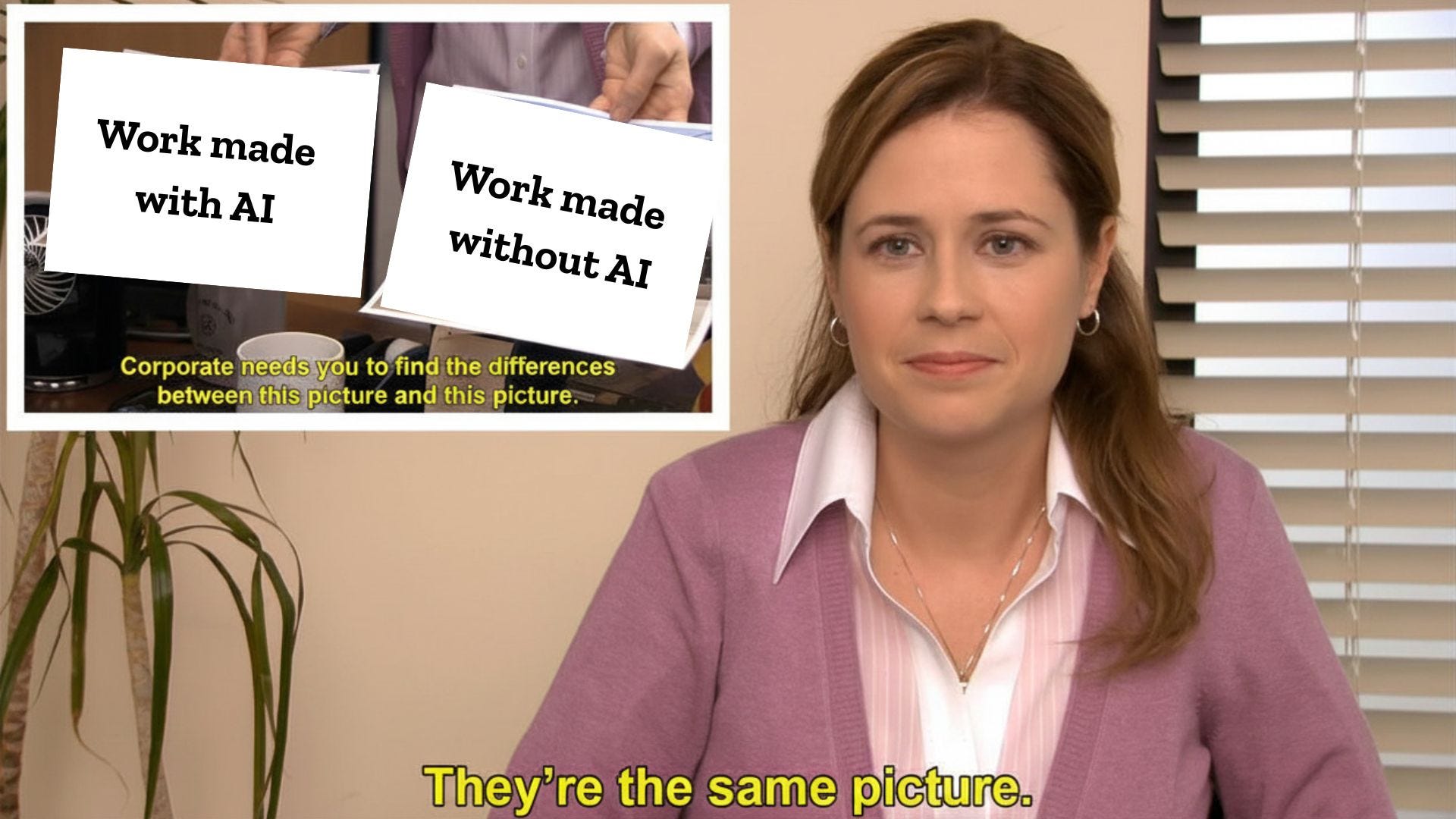
One of the things I thought about while I was trying to avoid wildfire smoke in the PNW is how squishy the difference is between good human work that’s AI assisted and good AI work that’s human assisted. How much are humans really in the loop? How much are people understanding the work that they are producing? Does it even matter?
That last one is more of an existential question.
I filed my column for Reworked on this topic before I left but I still had it stuck with me as I was on vacation. And it is more than separating human and machine.
The research from KMPG and UT Austin found that while nearly three-quarters of folks pushed back on AI supplied outputs (as you would hope), a third of those folks were completely ineffective in their pushback and actually performed worse than the people who copied and pasted Claude’s answer verbatim and moved on.
Managers have a hard time telling the difference too and, maybe more importantly, guiding people to use AI in a productive way. For as long as we have trained managers, we’ve focused on output quality as the North star. Do good work? Get a pat on the head. Good boy, now sit. Do bad work? Then we will talk about what you did wrong to get there and how to solve it.
Now that AI is obfuscating bad work behind the veneer of plausibly decent work, you can’t just judge on output alone because it is really tough to figure out. It was much easier when you could count em dashes or look for certain constructions to understand tells.
Those times of easy detection are disappearing (although Anthropic is trying to layer in some of that transparency).
What can leaders do to figure out if people are actually understanding and doing the important parts of the work? I know this is a radical idea but let me have this.
You talk to them about the work. Wild, I know.
You can read the rest of my ideas over on Reworked.
What else is happening this week(ish)?
North Korean IT Workers Use Real-Time Deepfakes to Beat Hiring Checks, Eleven Nations Warn. Eleven countries just warned employers that North Korean operatives are running live AI deepfakes through job interviews to land remote IT jobs, then stealing source code once they’re hired. This stopped being a niche threat a while ago.
ADP Leader: Most HR Leaders Are Asking the Wrong AI Questions. Joe DeSilva at ADP has a piece of AI advice actually worth following: stop asking where it can save time and start asking where it creates real business value.
While Layoffs Slow Overall, Job Losses in Tech Soar. Layoffs overall looking better isn’t the same thing as layoffs being over: total cuts are down 46% year over year, but tech cuts jumped 67% in July alone.
Who Controls the Past Controls the Future. The executives blaming AI for this round of layoffs are the same ones who said the pandemic hiring surge would last forever, and Laurie Ruettimann isn’t in a hurry to trust their timing twice.
Consequence Architecture. Chris Havrilla wants companies to get more specific than “human in the loop,” naming one actual person who owns every AI agent’s outcome before that agent runs. Worth doing: 88% of companies use AI somewhere in the business, and only 8% have anything resembling real governance over it.
Breaking the Applicant Funnel. The applicant funnel has been broken since AI let candidates flood it with volume, and Steve Hunt wants to replace it with something closer to a tournament, where candidates know the rules and get real feedback.
Economists Expect a Cooled Labor Market and an AI Reshuffling of White-Collar Work. Laura Ullrich and Svenja Gudell just launched Indeed Hiring Lab’s new quarterly survey of more than 100 economists, and slightly more than half of them expect AI to be a net drag on jobs over the next year.
We Made AI Compulsory. Now We’re Making It Contemptible.. Every platform built “write with AI” into the toolbar, and now those same platforms are shipping detection features to shame you for using it. Jess Von Bank‘s line for it is right: human error is becoming a CAPTCHA.
Trump Administration Expands Paid Leave Tax Credit for Employers. Treasury expanded a paid leave tax credit in a way that actually makes sense: employers can now claim it against insurance premiums instead of just wages paid directly, which should make it a lot easier for small and mid sized companies to use.
Psychological Safety at Work May Depend on the State of DEI Outside of Work. Barjinder Singh‘s new study found that workers who see their community as inclusive report feeling psychologically safer at work, even at companies that aren’t doing much to earn it. Your zip code is apparently doing some of your employer’s job for them.
Strategic HR Leader: A Title Everyone Claims, But Many Can’t Define. Every HR leader wants to claim the “strategic” title, and Jennifer McClure‘s point is that getting invited to the executive meeting was never actually it. Her data backs it up: AI meaningfully boosts HR’s strategic impact at some companies and does almost nothing at others using the identical tools.
Starbucks Is Ending GLP-1 Coverage for Weight Loss as Employer Costs Climb. Sarah E. Needleman reports Starbucks is cutting GLP-1 coverage for weight loss starting in October, now that those drugs eat up 11.4% of employer health claims, up from 6.9% in 2023. Expect more employers to follow until the price comes down instead of the coverage.
Slop Filters, Startup Millions, and AI-Powered Pink Slips. The Chad & Cheese roundup has a stat that matters: 43% of managers at large companies now let AI make layoff decisions with nobody checking its work.
Google’s Answer to AI Uncertainty: 15 Million Real Conversations, Mapped. Google mapped 15 million AI conversations across more than 800 occupations and found the technology touches 88% of US employment but does work in only about a fifth of the average job’s tasks. Jill Barth‘s rundown of the report backs the boring truth over the loud one: adoption is broad, but it’s shallow.
AI Is Driving Down the Cost of Outplacement. Chieh Huang‘s pitch for his AI outplacement startup Pelgo is blunt: no coffee shop on earth was ever buying its laid off baristas a $2,000 outplacement package, but at $20 a month, some of them might. Whether cheap outplacement actually helps anyone land a job in this market is still an open question.
CFOs and CIOs Starting to Treat Enterprise AI Like Traditional Tech: Is It Cost-Effective, Does It Work, and What Are the Risks?. CFOs were never going to stay sidelined on AI spending forever, and Josh Bersin says the hype cycle is ending in the most boring way possible: they’re demanding the same cost justification they’d want for any other software.
You Can’t Tell If You’re Learning Anymore. Jason Averbook‘s argument is that producing the work still matters even when AI can do it for you, because the struggle of doing it yourself is what used to prove you were actually learning something.
McKinsey Is Wrong. The Great Flattening Is Mostly a Relabelling Exercise. Toby Culshaw looked at the org chart everyone’s passing around, the one that flattens two management layers into oblivion, and noticed it mostly just renames Directors as Team Leads. Gallup’s numbers back him up: average span of control went from 8.2 direct reports in 2013 to 12.1 now.
New Podcast from John Vlastelica. Congrats to John Vlastelica on finally launching a podcast, which honestly should have happened years ago given how good he is talking about, well, anything.
A Sonnet in Your Inbox. Robin Schooling breaks down the farewell email as a stricter structure than most actual writing anyone does at work: an announcement, a gratitude section that doubles as commentary on who mattered, a highlight reel, and a deliberately vague sentence about what’s next.
The People & Progress Report: Let’s Flood the Zone. Researchers ran identical salary negotiation prompts through five AI models, changing only the persona, and a male candidate got coached to ask for $400,000 while the identical female candidate got coached to ask for $280,000. Kristy McCann‘s newsletter has nine more like that this week, plus a genuinely good summer playlist.
The How #29. Katie Achille‘s metaphor for leadership since becoming CEO of her PR firm this spring: some leaders are sails, providing agility, and some are anchors, providing stability, and the hard part is knowing which one a moment needs. I like that.
Plausible Deniability With a Subscription Fee. The EU delayed its high-risk AI employment rules again, pushing accountability requirements to December 2027, and Jackye Clayton has the line that captures what that delay actually protects: “We built a hiring process that never required anyone to look.”
Work Will Always Be There. These Moments Won’t.. Your company will cut you the moment AI makes it cheaper, and Mike Wood‘s advice is to do great work, then close the laptop and go be with the people who actually know your kids’ names.
Have a great rest of the week!