


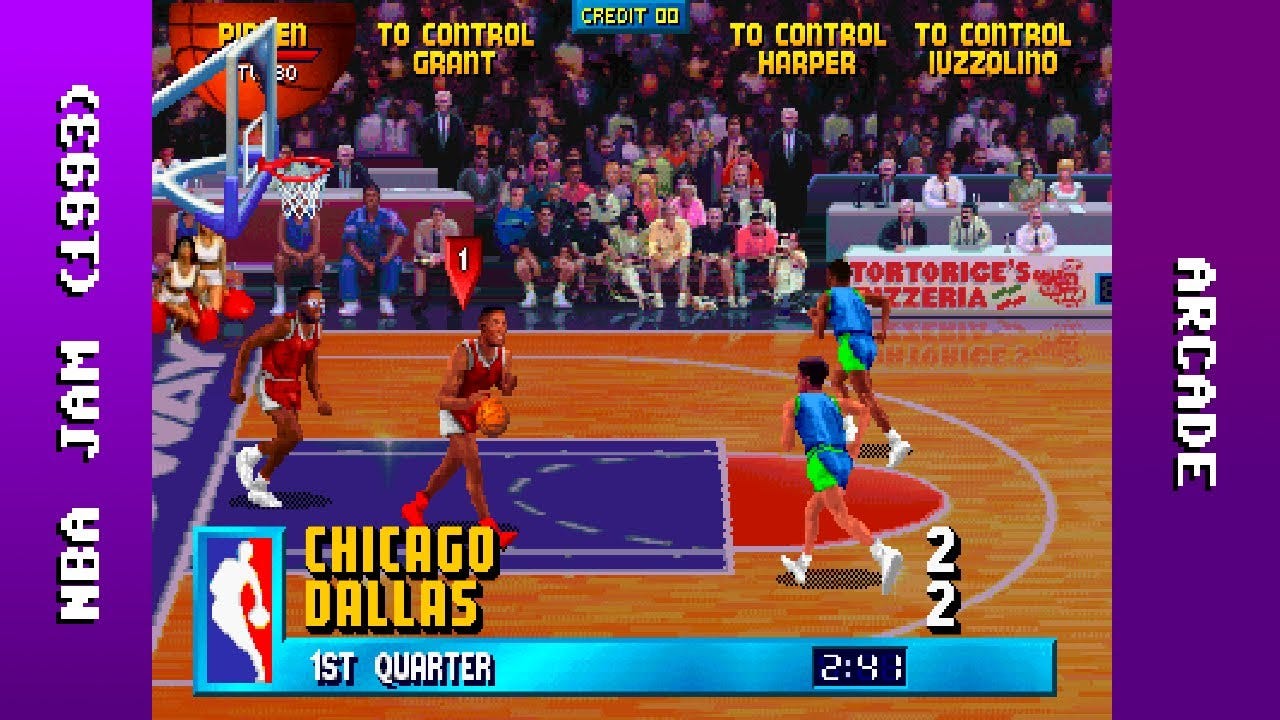
In the early 1990s, Mark Turmell was working as a game developer at Midway Games in Chicago. A Michigan native and lifelong Pistons fan, Turmell was working in the heart of the beast. If you know just one thing about 90s basketball, you probably know a name and his team:
Michael Jordan of the Chicago Bulls.
The Pistons were bitter rivals of the Bulls. They won championships a year apart from one another. They also both beat my beloved Trail Blazers so they can both take a hike as far as I’m concerned.
During that run up to historic decade, an arcade classic was in the works. NBA Jam was one of the first games to broadly license teams and players from the association. It was fun for casual arcade goers and home console players alike. A trip to Wunderland with a bag full of nickels would give you hours of entertainment back then.
After it was clear that the Bulls were a force to be reckoned with, Turmell decided to get revenge on the Pistons’ nemesis in the game play. The trick? He made the Bulls worse on last minute shots against just the Pistons. You can watch the interview below (starting at about 19:40).
The mechanism was subtle. It wasn’t a hardcoded miss like most people might assume. He just tipped the scale to make them shoot, on average, much worse than they had been shooting all game. It looked like a choke job.
It wasn’t discovered until 2008, 15 years after the game was released. And we only heard about it because Turmell told us about it.
A little harmless fun driven by a rivalry, right? I think so.
There is a lesson here, though. The original NBA Jam game was about 10Mb in size. That was a lot of code back then, but I’ve hit web pages that are bigger than that today. Someone could’ve looked for the bias and found it. And yet, for more than a decade, people couldn’t explain why Scottie Pippen kept missing buzzer beaters.
Do I think anything that malicious is happening in the AI solutions that hit the workplace? It seems unlikely (but not impossible).
What’s more likely is the system’s thumb being on the scale in some unknown way. While intentionality isn’t a good legal defense for doing the wrong thing for the right reason (or so I am told), it’s still bad when it happens and it’s really bad when it happens in a black box that very few people can understand.
The system we use to hire, develop, and manage people are much more complicated than a now 30+ year old game. Throw some non-deterministic AI into the mix and that complexity multiplies. Just ask Derek Mobley and Workday as they continue to hash out discovery and evidence.
For workforce leaders, you don’t need to be a developer to understand it all but you do have to know what you know and what you don’t. You also have to grapple with the risk of unknown unknowns as one Secretary of Defense put it. That might make the choice less about mitigating risk and more about avoiding certain tools altogether.
At the very least, you don’t want your employees and the very competent employee-side counsels out there to figure out on their own why they are missing their shots, basketball or otherwise.
What else is happening this week
Nearly One-Third of Companies Haven’t Deployed Any AI Tech in HR Yet, Study Finds. Only 31% of companies have deployed zero AI tools in HR, per Adam DeRose’s reporting on a new study. Budgets keep climbing anyway.
My Radiator Hose Blew in the Middle of Nowhere. Mike Wood’s family broke down on the Delmarva Peninsula, and the strangers who stopped, a grandfather and grandson with a VCR bolted into their van, fixed it for $100 and a thank you. He judged them by the van first.
How Technology Shapes HR, Not Just Enables It. HR’s tools and its culture shape each other. The keyword-matching ATS everyone’s used for 25 years came from what 1990s databases could compute, and AI-native platforms are about to do the same thing in reverse.
Humanity Will Not Design Itself Into the System. Banning phones in class or laptops in meetings is easier than agreeing on what they’re for, and Jess Von Bank’s point is that the same logic is coming for AI.
You’re Not Going to Like What Comes After Marketing. Steve Smith on G2 selling off three review sites and keeping the one AI cites, while Reddit lost 86% of its ChatGPT citation share in four days with no explanation. The “independent” evidence AI leans on is consolidating fast.
What If AI Costs More Than the Employee? Andrew Spence’s breakdown: a human costs €56.69 per task, an AI agent €88.26 once you count review and rework. Leaders aren’t ready for that conversation yet, but it’s coming.
YTD: What Actually Happened to Multiples in 2026. The SaaS Capital Index dropped from 5.58x to 3.82x EV/ARR in seven months, per Charles Bedard’s tracking. Airtable sold to Bending Spoons at 2.7x ARR, an 89% markdown from its 2021 peak.
AI Scales Everything, Including Bad Management. Meg Bear’s point: AI doesn’t fix bad management, it just runs the dysfunction faster.
The How #30: How Do You Know What You’re Seeing Is Valid?. Wikipedia’s accuracy sits somewhere between 80% and 98%, and every source is cited at the bottom of the page. Kate Achille tells us AI can’t say the same: reputable sites block it, so it keeps recycling the same handful of sources.
Powerpoint Dollars and Productivity. John Sumser’s first computer was a 1981 IBM PC, and he used it to calculate $7.5 million in “savings” that actually bought each worker five minutes a day. Same math showing up in LLM productivity claims now.
Unemployment Is Lying to You. Unemployment improved last month because 720,000 people left the labor force, not because they found jobs, says Brian Fink. Participation is already at a 50-year low.
Who’s Accountable When AI Blurs HR and IT?. Mark Whittle’s read: CHROs and CIOs will have to co-own AI ethics and skills-based talent management, because none of it fits neatly in either function anymore.
Nobody Wants to Own Candidate Fraud. Kyle Lagunas’s new report on candidate fraud makes one point: nobody owns it. “When nobody owns it, you can’t create accountability,” he says. H/T David Manaster.
Feds to Propose H-1B Fee That Would Stack With Controversial $100K Payment. The proposed $103,265 H-1B fee stacks on top of the existing $100,000 fee. Ogletree Deakins’ Caroline Tang is already calling the number a likely target for litigation.
OFCCP Dismantles Decades of Federal Contractor Affirmative Action Requirements. Sheila Abron and Jennifer Sandberg walk through the OFCCP’s three new rules, hitting 118,000 federal contractors and rescinding affirmative action requirements that have stood since 1965.
AI Emotion Tracking Is Taking Employee Monitoring Into Its Most Personal Territory Yet. Korn Ferry’s Dennis Deans on emotion-tracking AI: an employee who looks anxious might just be worried about their kid, not underperforming, and the algorithm can’t tell the difference.
How I Built an AI Writing Partner. Paul Slater keeps AI out of the actual writing, using it only for research and a final quality check. Drafting with AI and editing after, he argues, wrecks your own voice.
Another Tough Year Ahead for Employer Health Costs. Employer health costs are projected to rise 9.5% in 2027, past $19,000 per employee, per Axios’ Adriel Bettelheim.
The End of Company Culture as We Knew It. The foosball table was never real culture, Holly Grogan argues, just a symbol companies used instead of doing the work. Losing the symbol might force the real thing to show up.
Happy Employee Referral Day. September 1 is now Employee Referral Day, one more manufactured holiday for HR tech’s calendar.
Who’s Allowed to Help? Steve Hunt flagged Shonna Waters’s research on why disclosing AI help costs more trust than disclosing human help, even when AI does the better job. Her line: sounding like AI isn’t a knock on your intelligence, it’s a claim that the help you used isn’t seen as legitimate.
Across 128,000 Prompts Analyzed, 97% of Students Used the AI Tool the Way It Was Meant to Be Used. Kristy McCann’s numbers: Pearson’s AI tool got used correctly 97% of the time across 128,000 prompts. Women’s share of technical roles at AI companies fell from 23% to 19% since 2021.
The Generative AI Learning Penalty. Toby Culshaw shared research on Chinese students using AI for homework: they finished faster and scored higher, then did worse on the exam that actually tested what they’d learned.
Have a great rest of your week!