


Editor’s note: The newsletter is back with a new name and purpose. While most issues will not be so manifesto-like, I had to hit the gap hard after an extended break. Thanks for reading and if you like it, do all the sharing things.

In the waning days of World War II, a Manhattan Project scientist named Vannevar Bush wrote an essay in The Atlantic that described a problem that feels as fresh today as it did more than 80 years ago.
The world was producing knowledge faster than anyone could absorb it. Every field was generating groundbreaking discoveries. Every discipline was advancing at breakneck speed.
The tools available to make sense of it all were filing cabinets, index cards, and more books and papers than a person could ever hope to read.
Bush called it a problem of connection.
We had learned to grow information of incredible volume. We hadn’t learned to connect it.
His proposed solution, the memex, was a desk-sized machine that could store libraries of material on microfilm and, more importantly, let users link items to each other. Rather than organize by category like a filing cabinet or keywords like an index at the end of a book, it would work the way a curious mind creates sense from noise. The way the electrical impulses that drive a human heartbeat can feel like the beat of a Green Day song.
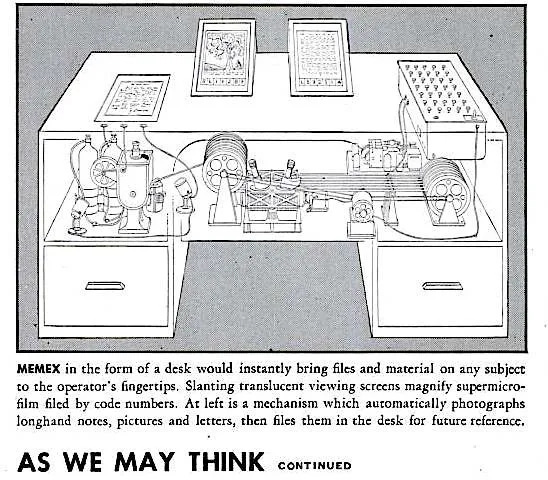
The technology to build the memex didn’t exist, but the core principle of this idea would shape eight decades of grappling with a now evergreen challenge: Too much information, too little wisdom.
Technology catches up with the vision
Twenty-three years later, Douglas Engelbart demonstrated the mouse, the graphical interface, and live hyperlinks to a room full of people who had never seen any of it. It became known as the Mother of All Demos. Alan Kay took those ideas further at Xerox PARC, building systems that treated the computer as a dynamic medium for thinking, not just data processing.
Then Bill Atkinson, a programming genius working on the original Macintosh team, had a psychedelic-driven vision on a park bench in Los Gatos. Human knowledge was siloed. Physicists knew things. Poets knew things. Musicians knew things. None of them were talking to each other, though.
His answer was HyperCard, released in 1987. It was my first experience with what would become the building blocks of the modern internet.
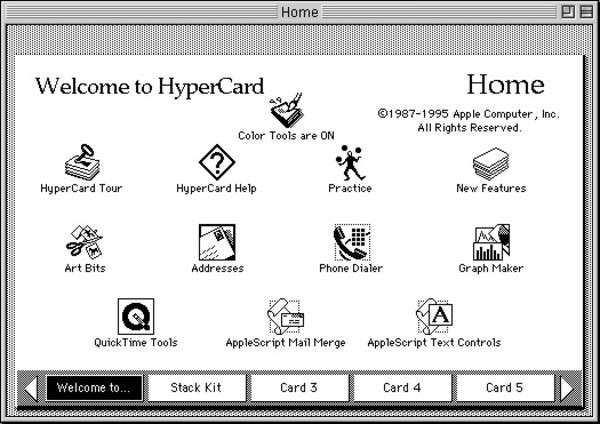
It was a virtual stack of cards that lived on your computer that could be linked to one another dynamically. Ordinary people with no formal computer training could build their own associative webs of knowledge. Teachers built learning tools, businesses built interactive knowledge bases, and I used it to build a choose-your-own-adventure style game that was about as sophisticated as you could imagine for an elementary school kid.
I believe poop was involved somewhere in the storyline.
Two brothers also used it to build a strange, contemplative game called Myst that became the best-selling PC game for nearly a decade.
HyperCard was, as Alan Kay later described it, symmetric. The person consuming information and the person creating it were on the same continuum. You could open any button and see how it worked. Like a jazz musician, you could use that knowledge play the same notes or you could iterate and expand.
Then Tim Berners-Lee, working at CERN on a NeXT workstation, built the first web browser. Inspired by HyperCard, the web as we know it today arrived. HyperCard faded as the web of information expanded beyond what we could store in a single computer.
But something important got lost in the transition.
We are building more file cabinets again
The web that actually emerged, the one we live in, is still mostly organized by taxonomy. Search by keyword, find your answer, and go on your way. The associative layer, the one where connections between unlike things produce genuine insight, mostly didn’t get built. Websites became self-referencing silos. Social media favored algorithms that give you more of what you already have.
We got abundance. We still didn’t get wisdom.
Information is cheap and plentiful. Wisdom is what you develop after you’ve seen enough information in enough contexts to recognize a pattern that isn’t obvious. It requires connection, not just retrieval. It requires someone or something that can look across the silos and say: These things are related, and here’s why it matters.
AI is arriving in organizations right now with a promise that sounds familiar. More information, faster. Cheap wisdom and abilities without all that thinking work. The implementations being built and deployed are largely retrieval and regurgitation tools.
Bigger, faster, and, sometimes, hallucinating filing cabinets.
AI is genuinely useful and it’s hard to describe how powerful it can be. We can’t build wisdom without knowledge. When I describe to my daughter how we researched before the internet, I might as well be talking about the Library of Alexandria.
But the way we use these tools is not solving the fundamental question that Bush was grappling with in 1945.
The tools that actually move people from information to wisdom are the ones that surface connections people wouldn’t have made on their own. They tell you not just what is true but what relates to what else, and why the relationship matters in your specific context.
When I see the information bloat, lack of vision or purpose, and thousands of copy and pasted AI posts that have the same beats, the same messages, and the same conclusion, I know we haven’t answered the fundamental question because we don’t even know what the question really is.
Connection, not collection
Every generation since (at least) 1945 has continued to make access to vast stores of information easier and declared victory. Certainly this will be the invention that solves our problems. Yet, information multiplies and we still feel like we don’t understand our world.
The hard problem is connection, not collection.
The tools we use to solve this problem reflect the assumptions of their builders. HyperCard was built by someone who wanted ordinary people to be authors to share their sense with the world, not just readers. AI is being shaped right now by the assumptions of the people deploying it.
Those assumptions are worth considering.
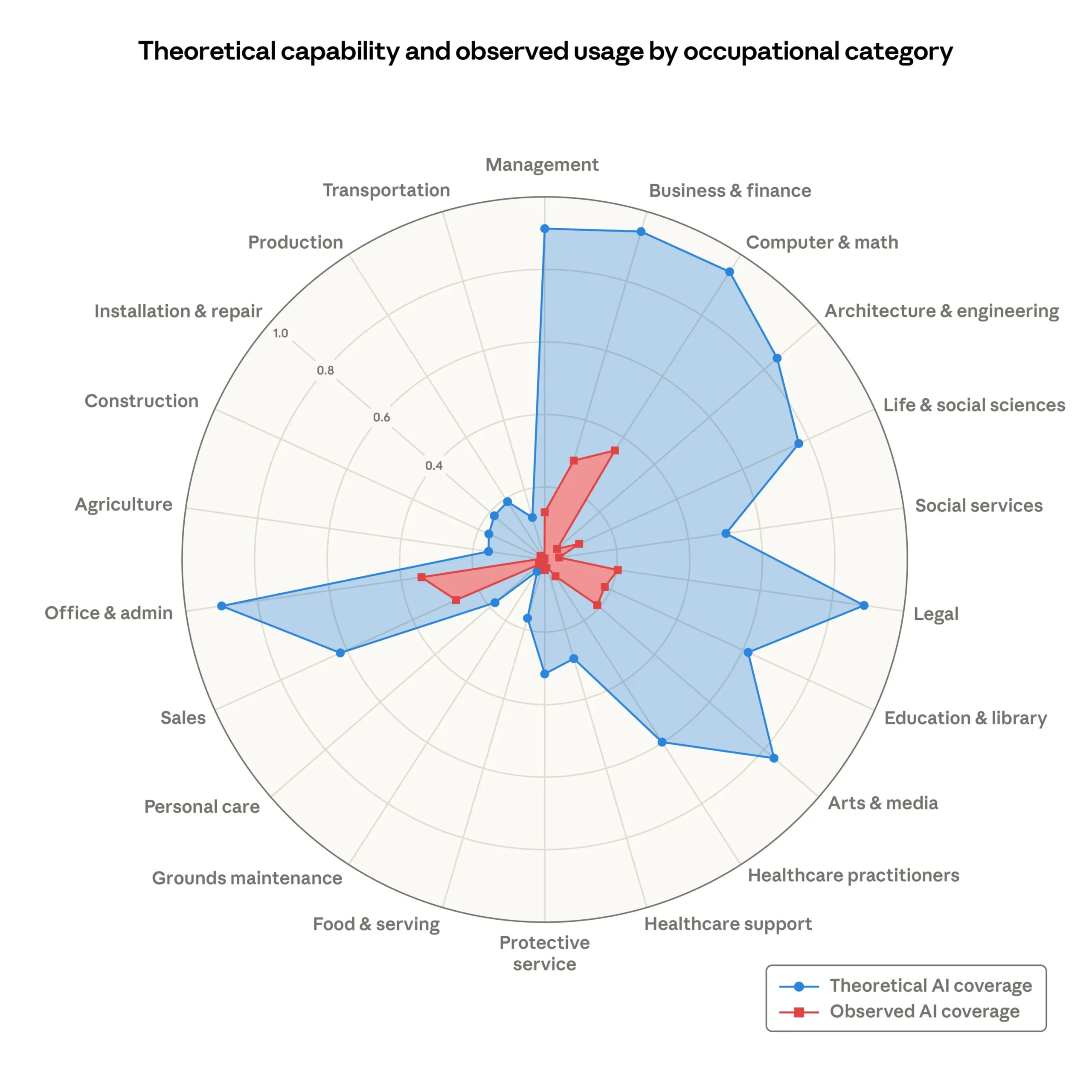
For example, when Anthropic publishes a study that reduces an occupation to collections of tasks and skills rather the connection of them, it feels like the record is skipping again. The theoretical AI coverage proposed is the type of fever dream that we’ve seen before.
There is genuine novelty with AI innovation (and, sure, a little bit of terror). That’s why it is so frustrating to see these abilities reduced to “answer engines” or debating which (contextually devoid, individual) tasks that AI can or cannot do.
Can AI help you connect with the world better? Can it create understanding where discernment is difficult? Can it help you make better decisions than you would’ve made on your own? Can it make you a better person or give you abilities beyond multiplying my own foolishness at unbelievable scale? Can it make something better that people actually want?
I think so because I’m a silly optimist, but it’s not how we’re using it.
I don’t want a faster, scaled up version of my thinking or abilities when it can’t crib the connections I’m making in my head. I don’t want a machine that can take the collection of tasks that makes me good at what I do without the ability to ask, “Wait, why are we even doing this?”
Someone still has to ask the right question. Someone still has to decide what the pattern means for this organization, this moment, these people, and find the right medium to tell that story so that someone who gives a damn will understand.
If all we are doing is just reinventing a faster file cabinet (again), then what the hell are we doing? Creating a brainless, context-less collection of information, tasks, and skills that can scale stupid work 10x?
I believe Vannevar Bush’s vision is still out of reach, at least in practice. It’s worth asking if we as people want to use the very capable technologies we already have to build wisdom or connection or if we are always going to try to settle for shortcuts and speed?
I think there is still a market for people who care about making sense out of noise rather than noise out of sense. Let’s hope so, at least.