


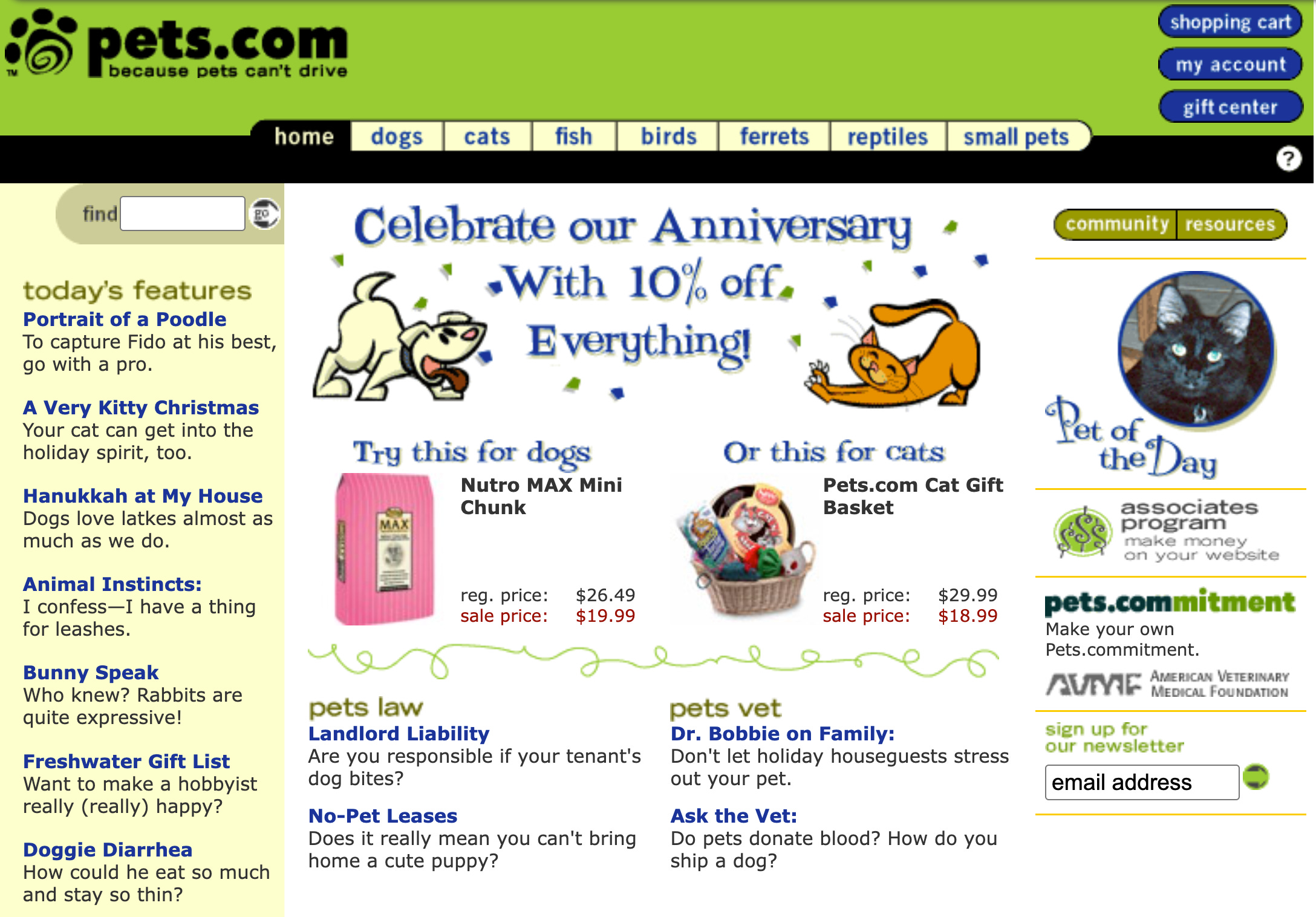
The Pets.com sock puppet first showed up in August 1999. By Thanksgiving it was a 36-foot balloon in the Macy’s parade.
It didn’t stop there.
If you watched Super Bowl XXXIV in January 2000, you saw the puppet’s spot too. It cost $1.2 million, and USA Today’s Ad Meter ranked it fifth.
The business behind the puppet sold very little, though. Where did the money go? Advertising.
From February to September 1999, its first fiscal year, Pets.com took in $619,000 in revenue and spent $11.8 million on ads. That one Super Bowl spot alone cost nearly twice what the company earned in that whole period.
It went public in February 2000 at $11 a share and raised $82.5 million. Not bad!
Robert Smigel, who created Triumph the Insult Comic Dog, said the now famous sock puppet was a rip-off of his character. Pets.com sued him in April 2000 for $20 million.
Triumph, being Triumph, answered on Late Night with Conan O’Brien with a skit humping the Pets.com puppet in a bathroom. I won’t link to it but it is certainly one way to respond to a lawsuit.
The good times never last, though. On November 7 of that same year, it announced it was liquidating, and the stock was at 19 cents. But we can’t blame Triumph for that one (a judge would dismiss the lawsuit in February 2001).
Pets.com was the poster child of a bust cycle. But they weren’t the only ones. Of the 14 dot com companies that advertised at the same Super Bowl, just four were still active 15 years later (Monster and HotJobs were both advertisers too).
Better to burn out than fade away? I don’t know but people rarely talk about Computers.com in the same way Pets.com gets talked about.
Fast forward to 2017 and PetSmart paid $3.35 billion for Chewy, then the biggest e-commerce sale ever.
Pets.com was right that people would buy pet food online. They were just the better part of a decade early.
Why am I talking about a puppet?
HR vendors spent last month pitching HR leaders on AI agents that would change how the whole function works.
They are ahead of the market. And I don’t know if it’s just by a little.
The buyers I talked with were working on smaller things, like texting candidates faster and getting data from different systems to agree. I haven’t met an HR department that has all the staff it needs, and most of the people I talked with were burnt out and working on the basics.
What those buyers want is closer to the old Ronco promise of set it and forget it. They get something that works without adding to their team’s load. From talking to many of them, I don’t think there’s a real appetite for rebuilding the whole organization around agents. There will be some that transition but it will be slow, role-by-role.
The vendors might be right about where this eventually ends up. But I started a podcast around 2010 or 2011, when nobody listened to podcasts, and now everybody has one.
Being right too early can push buyers away just as well as being wrong.
In the meantime, buyers are working on smaller things with partners who understand that transformation looks different for everyone. I wrote about the dozens of HR leaders I heard from doing similar work, in my Reworked column. Take a read. Or don’t.
What else is happening this week
Be Sports Minded About AI With Dr. Dafna Aaronson. Love when Laurie Ruettimann gets engrossed in sports, and this time her guest compares coaches and general managers to mini data scientists who still make the call.
People Are Not Tired of Change. They Are Tired of Failure. Jess Von Bank says people are tired of initiatives that leave things feeling the same, and I’d add, or even feeling like failures.
Women Supporting Women in Action. This is really cool! Mel Plett is sharing Francesca Ranieri’s At Dawn, a free experiment that more than 300 women across 28 countries signed up for in under a week.
Three Buyer Archetypes: Teach Me, Show Me, Prove It to Me. I remember this well. Jonathan Goodman gives a look inside how he thinks about go-to-market, using three buyer archetypes from a persona project for a large background screening company.
Monthly Research Recap: October 2026. A monthly roundup from 3Sixty Insights on agentic recruiting products from ZoomInfo and Paychex and the gap between vendors’ AI promises and buyers’ readiness.
The Buried Lede in Anthropic’s Own Research. Gabriela Burlacu says the buried lede at the bottom of Anthropic’s research on its own work is that it’s hard to imagine pro-worker AI adoption where workers hold no financial stake in a successful rollout. Super good piece.
Unleash Paris 2026: What I Took Home. Anita Lettink spent three days at UNLEASH in Paris and says the AI conversation moved from what it could do to what it should do and what it costs.
The Top 10 Workplace Trends for 2027. Dan Schawbel’s crystal ball is working. His Workplace Intelligence Weekly says AI became the most cited reason for layoffs in 2026, though the evidence that those cuts improve returns is thin.
The Best HR & People Analytics Articles of October 2026. David Green’s always good monthly roundup opens with McKinsey research finding that capturing more value from AI means rethinking how work is structured and decisions get made.
HR Tech 2026: Ten Observations From the Show Floor. Good to get David Manaster’s read on HR Tech, which includes his observation that three-year-old platforms already feel like legacy.
Undermining the Value of Creative Strategy in Talent Acquisition. I’ll take the Rick Rubin reference. Brian Fink uses it to argue that talent acquisition shortchanges creative strategy because dashboards reward whatever looks defensible.
My HRTech 2026. Another good HR Tech rundown, this one from John Sumser, who took about forty vendor meetings and calls fraud “mostly a made-up problem.”
Beyond the Conference: What We’re Taking Away From HR Tech. Good takeaways from the IA crew, with Jennifer Payne, Sammye Walton and Mary Faulkner sharing what stayed with them and what HR leaders might bring back to their own teams.
We Don’t Want the Fastest Surgeon, Right?. My take: speed (and cost) will never stop being an issue, but John Vlastelica is right that the emphasis is wrong. He wants talent advisors measured on the quality of candidate evaluation, not speed.
The Vital Debate We’re Not Having. Matt Alder has strong takeaways from UNLEASH, including how much vendor messaging covered what AI can automate and how little covered what should stay with humans.
The Model Made $16B. The Buyer Made $0. Good insights here from Rob Catalano, who sets Anthropic’s $16.3 billion in six months of revenue against Apollo’s chief economist saying AI has delivered no financial payoff outside tech.
LinkedIn’s Penetration Rate by Country Post Microsoft Q1 FY27. The Talent Intelligence Collective notes that Microsoft’s latest earnings no longer break LinkedIn out as a business, even as LinkedIn claims 1.4 billion members. Good insights about LinkedIn here.
The Evolution of HR Technology. Steve Hunt revisits his visions of the future from 2010, 2016 and 2022 and ends on which technology pays off soonest. Not your usual HR Tech roundup.
The How #32: October 30, 2026. I’m with Kate Achille on her HR Tech takeaways, which start with her advice to clients to stop touting their AI and to point to what it does.
Nobody Looked. Kristy McCann covers micro1’s $1 billion plan to buy company data and Gallup’s finding that U.S. engagement fell to 29% in the third quarter, and this is solid.
Are We Building a Future No One Wants?. Good questions from Mike Wood, who spent two weeks in Vegas at Workday Rising and HR Tech and found employee experience missing from the expo floor.
While You Were Working | Volume 6. Engagement being down is huge, and Robin Schooling’s roundup has Gallup’s number at 29%, the first time below 30% in fifteen years.
Microsoft and the New Employee Disengagement Playbook. Steve Smith has all the bases covered, tying Microsoft’s exit offer to what he puts at nearly $40 billion of capex in a quarter and saying the money is moving from people to processors.
Sold, Pivoted, or Stalled. Which Is Your HR Tech?. Good info from George LaRocque, who says Work Tech providers without gravity face three possible outcomes in 2027.
Workday Did What It Said It Would. I know this newsletter is over Workday, but this was too good not to share: Stacia Garr says Workday did what it promised at Rising and that customers, not Workday, will set the pace.
Hiring Isn’t Dating, Y’all. Yes, I have hated this since I heard the idea. Kristina Minyard shares Cieara Hitt’s DisruptHR Huntsville talk, “Hiring Isn’t Dating: Stop Looking for Butterflies.”
What Are We Not Talking About When We’re Talking About AI?. Loved this video, where Reworked Editor in Chief Siobhan Fagan asks people at HR Tech what we’re not talking about when we’re talking about AI.
Zombies Used to Want Brains. Rep Cap says the real horror this Halloween is content nobody bothered to read before it went out. Unfortunately that isn’t just a Halloween thing.
In the news
Fewer Jobs, New Opportunities: AI Is Changing What’s in Store for New Hires and Managers Alike via Northeastern Global News
Agentic AI in the Workplace via Littler
USCIS Plans to Abolish 60-Day Grace Period for Certain Nonimmigrant Workers via HR Morning
Anthropic Flags U.S. Immigration Policy as a Risk Factor in Its Historic IPO via Fortune
September 2026 JOLTS Report: Eerily Quiet via Indeed Hiring Lab
Evaluating New LinkedIn Labor Market Tightness Indicators via Liberty Street Economics
More Disney Layoffs Coming? via HR Executive
Microsoft’s 60,000-Person Buyout Offer Hints at a Future With Fewer Workers and More Equipment via Fortune
AFL-CIO Drafting ‘Gold-Standard’ AI Legislation via Semafor
About 1 in 3 Workers Say They’re Faking Their Skills via HR Dive
AI Makes Work More Enjoyable, Yet One in Four Workers Plan to Quit via HCA Magazine
Have a great rest of your week!