


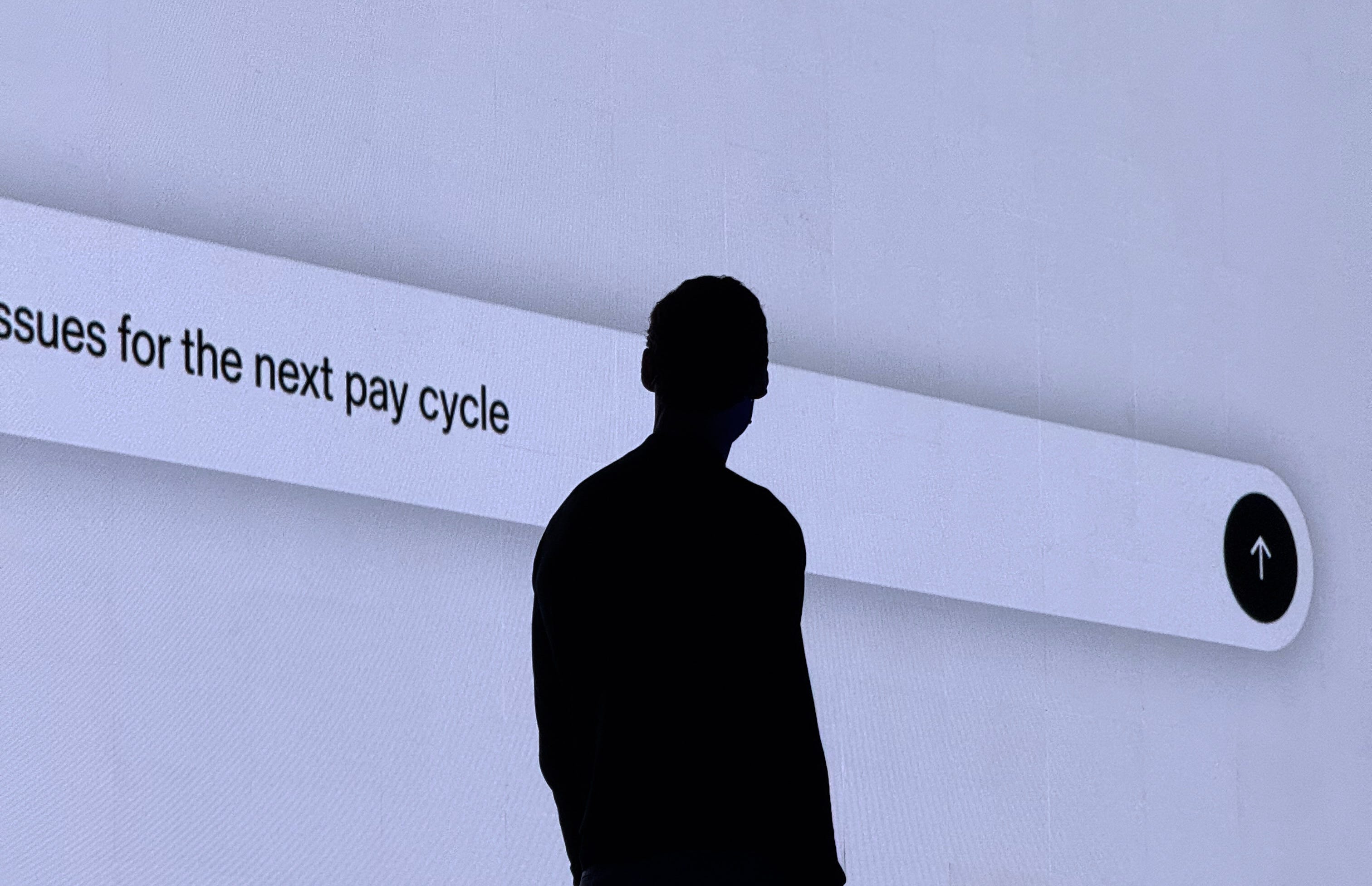
Hello from the road. I am taking in Workday Rising for the first time. And it’s my first user conference in awhile so I forgot a few things.
User conferences are weird. Thousands of people fly to Las Vegas to spend four days on one product, and the product is the whole agenda. Most events have a hundred vendors with a hundred opinions. Rising was centered on one.
This year it also has one idea and it should shock no one. The Innovation Keynote was AI from start to finish. I wrote up the full set of announcements for Reworked: a new Sana home screen and recruiting agents that scan open reqs while the recruiter is away.
I walked in skeptical. Do we really need AI in payroll? Co-founder and newly reappointed CEO Aneel Bhusri said it himself from the stage. HR and finance have zero margin for error, and you can’t run a payroll at 90% accurate.
So who’s asking for this?
Customers, it turns out. A lot of them.
Workday told the room that about 6,000 organizations now run its agents in production, up from only a few a year ago, and that a million people have access to the Sana self-service agent.
What I heard wasn’t much different. I’ve talked to about a dozen customers who are using AI and agents and want to do more of it.
Amy Cavasos runs the Workday team at Lemonade. It’s four people covering everything from payroll to recruiting. She wants a payroll agent tuned to Lemonade’s own anomalies, so her team stops combing through every pay cycle and gets the odd stuff surfaced. She wants the same thing in accounting, with a zero-day close as the goal so her team isn’t up until 2 a.m. at the end of the month.
Is some of this clamoring for agents shiny object syndrome? Sure. Finance and HR teams watch their colleagues in IT and marketing use these tools all day, so of course they want in. But back-office functions are underresourced almost all the time, and if you want more done with the same people, some automation is the obvious remedy.
The harder part is control.
I came to Rising ready to push on controls and governance. I barely had to. Everyone brought it up before I did.
Dean Arnold, Workday’s VP of AI Platform, told me agents run around the clock and go looking for holes, and that you can count on one already hitting your endpoint. Workday’s answers include Agent Passport, which tests agents against security standards, and spend controls: budget alerts now, hard caps on specific agents by January. Customers are demanding those, Arnold said, and some have told Workday they’ll adopt once the controls exist.
Data that leaves Workday got the most attention. CTO Gabe Monroy described the lawless way: an agent on a custom MCP server that returns requisitions its user was never meant to see. “You can export your data, but you can’t export the rules that govern the data,” he said. They don’t want data copied out of their system but they still want the advantages of AI.
Open, but controlled. That’s a big ask.
I have no reason to doubt it’s what most customers want, so I’ll take that as given. I still wonder how much of the genie goes back in the bottle. Arnold said anyone who can describe a task to a coworker can describe it to an agent, which means building one is about as hard as asking. What happens when a governance rule gets in the way of someone with a deadline? Will they stay in the safe constraints or will they do what life does: find a way.
And the demos were slick as you would expect. A 50-person headcount request shrinking to 42, or an audit agent catching two near-duplicate invoices. They looked good. But that same agent has to meet thousands of different workforces and your own financials outside of a demo
Workday has real advantages here. Bhusri called SAP and Oracle “dinosaurs” on stage. It’s a line, but if you look, there’s an argument under it. Workday says it was built with one data model, one security model and one version of the software, so agents inherit permissions that already exist. That should make its promises easier to deliver than the older suites can do reliably.
Even so, the customers I talked to are going carefully. Cavasos said Lemonade hasn’t handed a single SOX control to AI, for example. She wants agents to live inside Workday’s security model. Pushing Workday data out into a tool like Slack, though, could skip past manager and cost center restrictions, and she said her team doesn’t know yet what those guardrails need to be. She lived through Y2K, she told me, so she sees everything through the lens of what could go wrong.
Workday’s own payroll agent isn’t due for early adopters until early 2027. Many of the other features shared on stage are available to organizations on early access. Workday knows it has a fine line to follow here.
How far does this go, and how fast? That will be the real proof. If we see real customer stories with real work being done by agents at the next Rising, I imagine that there will be huge demand. HR, finance, and IT aren’t on a hiring spree and every organization is asking for more.
What else is happening this week
ADP’s Roadmap From Agents That Assist to Agents That Own. Most of ADP’s agent results are pilots or projections, per its own footnotes, and Stacia Garr still thinks accountability has to sit with a human. Nice update.
What the New York Times Missed About Universal Basic Income. Who would’ve thunk big media gets the nuance wrong? Laurie Ruettimann says the Times’ basic income story follows three formerly homeless people through one-year pilots, which can’t judge a permanent program.
Two Truths About AI Tools at Work. If you aren’t reading Gabby Burlacu, you should. She says we treat AI tools too much like humans and measure them by individual output when most work is collaborative.
How HR Should Redesign Work to Unlock Business Value. So many good guests in David Green‘s Series 57 wrap-up, including the people chiefs at Cisco, Snowflake and Allianz, on redesigning the work itself.
Before You Renew Your HR Tech Contract. What happens to your HR tech bill if headcount drops 15% and AI credits push the total up? Strong questions from Kevin Wheeler to ask before you renew.
Writing in Dyno. Brian Fink says keep posting, because writing is how you find out what you’ve got. I relate to this, especially when it feels like I am screaming into the void.
AI Governance 11: System Errors. Governance has been a huge issue. John Sumser notes a collection of agents fails more often than its individual components, and failures cascade.
The Early-Career Crisis Demands a Crisis-Level Response. Jason Averbook calls for a crisis-level response, citing Stanford data that finds employment for 22- to 25-year-olds in AI-exposed jobs 19% below where it would have been relative to less-exposed peers. 100% right.
Building a Safe Multi-Agent AI Operating System: Lessons From HR and Ferrari. Josh Bersin argues for specialist agents with clear owners over one do-everything agent, a good frame for thinking about how agents find their role.
This Is the Future of Work. Sobering reality: Mike Wood counts 573,195 announced job cuts this year, while Revelio Labs data has remote-capable jobs at U.S. companies growing 42% faster offshore than at home from 2019 to 2024.
The First Job: Lessons, With Interest. With the share of teens holding jobs down from 50% in 1978 to roughly 31%, Robin Schooling looks at what her Spencer Gifts first job taught her. Always good stuff.
The New Era of Talent Assessment & Candidate Selection. Great recap from Steve Hunt of the SIOP Leading Edge conference, including “IO washing,” where many assessment vendors claim their products rest on IO psychology with no apparent scientists involved.
Do You Like Scary Movies?. I don’t like scary movies but this is our reality. Kristy McCann‘s roundup opens with an AI model’s made-up tip on an unsolved homicide that Anthropic took 72 days to notice.
What a Flooded Basement Is Teaching Me About Grace Under Fire. Yolanda Fraction wrote this the morning a ruptured water heater flooded her basement: calm is a practice. Something I am working on.
Fewer Than Half of Enterprises Have an HR Data Integration Strategy. Early look from Stacey Harris on Meg Bear and Amy Wilson‘s show: most enterprises deploy AI even though fewer than half have an HR data integration strategy. A real issue.
Moneyball for HR Proven Right: What the MLB Playoffs Revealed About System Health. I always enjoy these takes from Andrew Gadomski, who says the MLB playoffs proved his Moneyball for HR predictions right.
September’s Work News and Three Possible Futures. Mel Plett talks through three possible futures, plus one piece of good news for nervous tech workers. So much happened in September.
The WorkTech Market Gravity Watch List. Gravity Leaders and Gravity Builders, alphabetical on purpose: George LaRocque‘s watch list is an interesting approach and worth paying attention to.
In the news
Google Debuts Gemini, an All-Purpose Agent for Work via Reworked
Your Employees Are Building AI Agents. Do You Know What They’re Doing? via CIO
SAP Lays Out Its Autonomous HCM Plan at Connect via SAPinsider
Young Bearing Brunt of Hiring Slump, Warns CBI via Personnel Today
Three Recruiting Technology Companies Have Vanished From LinkedIn via ERE
Ashby’s Recruiting Platform Is Quietly Cornering Greenhouse’s Mid-Market Base via Recode
HackerRank’s AI Interviewer Chakra Goes Public After 500,000 Interviews via AI In Context
HR Giant Ordered to Pay $400,000 to Job Applicant Who Wanted to Bring a Service Dog to Work via Business Insider
Ex-Monster.com Founder Launches Boomband Marketplace in New England Region via HR Tech Feed
Glassdoor Debuts Glassdoor Recruiter to Modernize Hiring via CHROFirst
I Work 4 P.M. to Midnight, and I Love My Schedule. Here’s How I Make Time for Sleep, the Gym, and Relaxing. via Business Insider
Fake Job Applicant Statistics 2026: 78.9% Target Engineering via Noon.ai
HR Is Adding AI Recruiting Agents Before It Knows How to Audit Them via HR Executive
Four-Day Workweek Promises Need Specifics in Recruiting via HR Executive
Four New California Laws Reshape the Rules for Workplace AI via The National Law Review
Trump Administration Issues Healthcare Price Transparency Rules via SHRM
Pending Reforms to Non-Compete Clauses: What Employers Should Be Doing Now via HRD Australia
Private Sector Hiring Slows Modestly After 5 Weeks of Acceleration via Staffing Industry Analysts
IMF Warns Global Economy Nearing ‘Limits of Resilience’ via Axios
Federal Reserve Board Releases Results of the 2025 Survey of Consumer Finances via Federal Reserve Board
Walmart to Offer 250-Plus Free Medications, Including GLP-1s, to Employees via ETHRWorld
America Is Running Short of Workers Needed to Build Its Next Wave of Infrastructure via Allwork.Space
Zoho Freezes Pay Hikes, Cuts Marketing Spend Amid Rising AI Costs: Sridhar Vembu via ETHRWorld
Improved Tax Incentives Encourage Employers to Help Workers With Childcare via WGLT
Workers in the AI Era Need These Skills, According to 4 Executive Leaders via CNBC Make It
Have a great rest of your week!